India Adds 5 Sites to UNESCO Tentative List
Why in News?
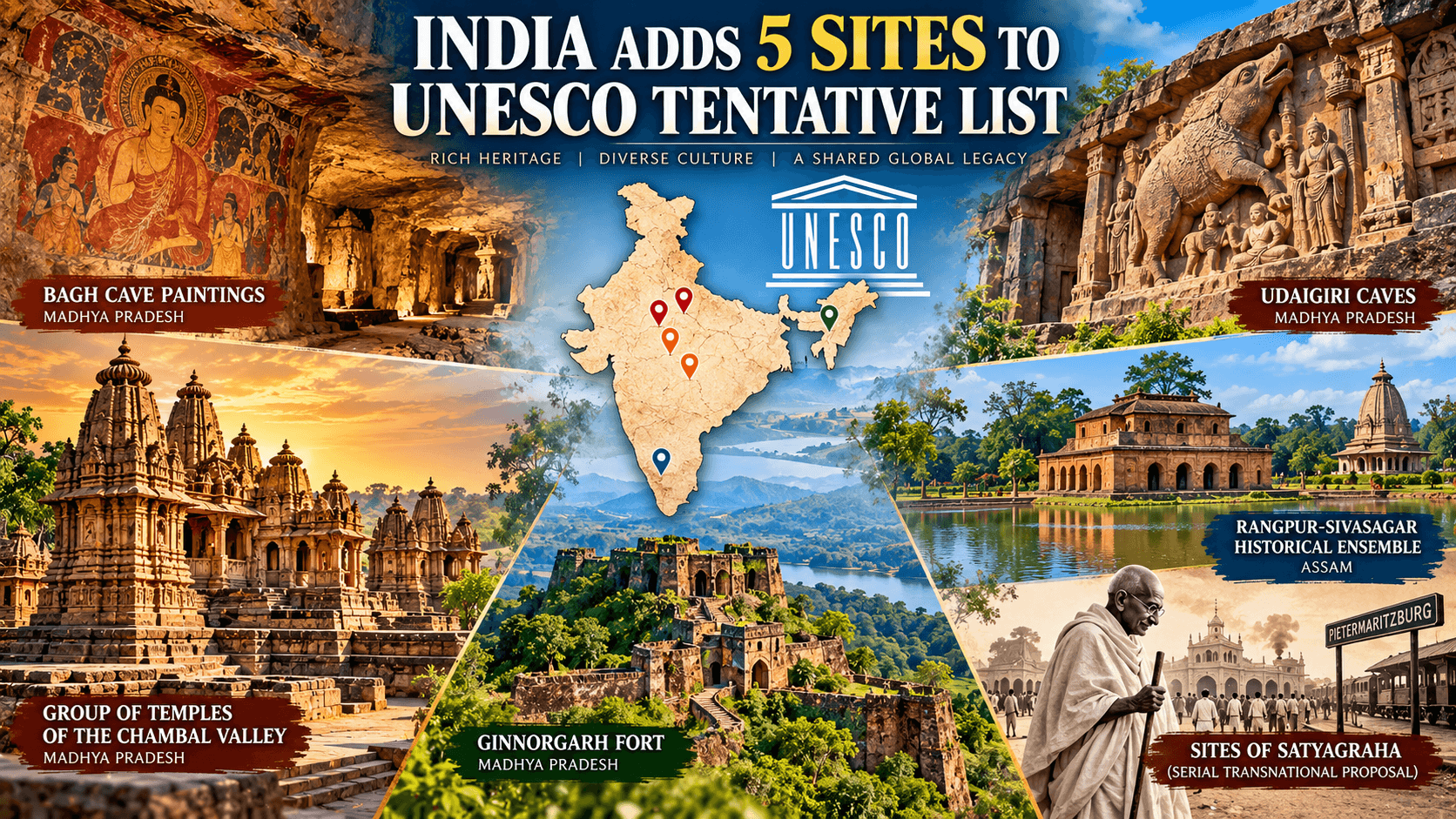
Recently, the Ministry of Culture and Tourism has added five new heritage properties and serial transnational proposals to India’s UNESCO Tentative List. With this, the total number of Indian sites on the Tentative List has now gone up to seventy-eight.
Bagh Cave Paintings (Madhya Pradesh)
Located on the southern slopes of the Vindhyas along the Baghni River, this is the only sandstone outcrop in an otherwise basaltic area.
The site has nine rock-cut Buddhist caves. Built during the Gupta period (4th-6th century CE), ancient inscriptions from 358-487 AD mention names like 'Valkha' and 'Vikha-adishthana,' showing it was not just a religious retreat but also an important political and administrative center.
The complex is linked to the Buddhist monk Dataka and served as a major monastic center with Chaityagrihas (prayer halls), Viharas (living quarters), pillared verandas, and stupas.
Its murals are famous for their link with Ajanta; both use earth and lime plaster with natural colors like lapis lazuli (blue), terre verte (green), red-yellow ochre, and carbon black. While technically like Ajanta, Bagh has its own regional style and is considered part of the great Asian mural tradition along with Sigiriya in Sri Lanka and Mogao in China.
Udaigiri Caves (Madhya Pradesh)
These are 20 rock-cut caves excavated mainly in the late 4th to early 5th century CE under Gupta rulers Chandragupta II and Kumaragupta I.
The caves are famous for their powerful Vaishnava art, especially the huge Varaha panel, where Lord Vishnu as Varaha rescues Goddess Earth (Prithvi), symbolizing cosmic restoration and royal power, and the reclining Anantasayana Vishnu.
While mostly dedicated to Vishnu and Shiva, there are also Jain caves here, showing the religious tolerance of the Gupta era. Architecturally, Udaigiri is a crucial link between the early rock-cut caves and the later free-standing temples, with features like a proper sanctum, mandapa, and axial entrance.
Artistically, it blends Mathura and Malwa styles with classical Gupta art, which later became a model for temple architecture in north and central India.
Group of Temples of the Chambal Valley (Madhya Pradesh)
This group includes the famous Bateshwar, Padavali, and Kakar math temples in Morena district, built between the 8th and 11th centuries CE under the Gurjara-Pratihara and Kachchhapaghata dynasties. They are a brilliant example of regional Nagara-style architecture, showing how the style evolved in central India. Key features are the axial layout of temples, tall and ornate shikharas, intricate sandstone carvings, and amazing dry masonry, where huge stone blocks are perfectly interlocked without using any mortar.
Ginnorgarh Fort (Madhya Pradesh)
Located deep inside the Ratapani Wildlife Sanctuary, this is a tribal hillfort that uses dense forest, ravines, and steep slopes as its natural defense. It was the main fortified capital of the Raj Gond rulers of the Garha Kingdom from the 15th to 18th centuries. After the fall of the legendary Gond queen Rani Durgavati in 1564 CE, the region came under Mughal control, but the local Gond influence continued, giving it a layered history. The fort has a unique three-part layout showing tribal military planning:
Morcha: outer defensive zone
Amghera: middle zone for administration and soldiers
Inner Royal Core: inner zone with palaces for the royal family
Its construction is special too, built with local stone, lime, and surkhi, bound together with organic materials like jaggery and Bael pulp. The ruins of Rani Mahal still have rare Gond court paintings.
Overall, it shows a beautiful mix of indigenous Gond style with Mughal/Indo-Islamic features like engrailed arches and multi-faceted pillars.
Rangpur-Sivasagar Historical Ensemble (Assam)
This is the political and cultural heart of the Tai-Ahom kingdom. The Ahoms came from present-day Myanmar in 1228 CE under Siu-ka-pha and ruled the Brahmaputra Valley for six hundred years. They famously defeated the Mughals in the Battle of Saraighat (1671) and ruled till the Burmese invasions and British takeover through the Treaty of Yandaboo (1826).
The main centers are Rangpur (capital in 1704) and Sivasagar.
Architecture: Initially built in wood and bamboo, Ahom architecture later shifted to brick and stone. Their temples (Dols) have a unique octagonal plinth linked to Ahom cosmology, topped with a hybrid shikhara.
Water Engineering: They were masters of water management. Using the Paik system (forced community labor), they built huge tanks like Joysagar, Gaurisagar, and Sivasagar. They used techniques like Nagastambha (wooden pillar to find water source) and moats (yamunas) to maintain water level and prevent erosion.
Key Monuments:
Rang Ghar: One of Asia's oldest amphitheaters, with a roof shaped like an inverted Ahom boat, used for royal games and Bihu celebrations.
Talatal Ghar (Kareng Ghar): A royal palace-cum-military base with 4 floors above ground and 3 underground.
Ghanashyam House: An 8-roofed Bengali atachala-style building with terracotta work and Islamic touches.
Special Features: The site also has Pohugarh, considered Asia's first open-air zoo, and the Namdang Stone Bridge (1703), made mostly from a single stone block using traditional organic mortar, which has survived floods and earthquakes.
Sites of Satyagraha (Serial Transnational Proposal)
This is proposed as a transnational property with 9 sites, 2 in South Africa from Gandhi's 21-year stay (1893-1914) and seven in India, showing how Satyagraha spread and evolved.
Beginning in South Africa:
Pietermaritzburg Station: Where Gandhi was thrown out of a first-class train in 1893—the turning point in his fight against racism.
Phoenix Settlement (1904): His first ashram and base for his newspaper Indian Opinion, where he promoted truth and non-violence.
2. Starting in India:
Champaran, Bihar (1917): Site of his first Satyagraha in India.
Sabarmati Ashram, Gujarat (1917): Base for the famous Dandi March / Salt Satyagraha in 1930.
Mani Bhavan, Mumbai (1917-34): His base during the Non-Cooperation and Civil Disobedience movements.
3. Later Phase in India:
Harijan Sevak Sangh, Delhi (1932): Founded to fight untouchability and promote social equality.
Sevagram Ashram, Wardha (1936): Focused on rural development, self-reliance, and Swaraj.
Aga Khan Palace, Pune: Where Gandhi was detained during the 1942-44 Quit India Movement. It also has the memorials of Kasturba Gandhi and Mahadev Desai.
Gandhi Smriti, Delhi: His last residence, where he was assassinated on 30th Jan 1948.
About UNESCO Tentative List
The Tentative List is a list of sites that a country feels are of outstanding global value and deserve to be a World Heritage Site. Being on this list is compulsory—as per UNESCO rules, a site must stay on the Tentative List for at least one year before it can be officially nominated for World Heritage status.
India's Status: With the 5 new additions, India now has 78 sites on the Tentative List. At present, India has 43 inscribed World Heritage Sites, with recent additions being Santiniketan, Sacred Ensembles of the Hoysalas, and Assam's Moidams.
Conclusion
With the addition of these 5 diverse sites, such as Udaigiri Caves, Chambal Valley Temples, Ginnorgarh Fort, Rangpur-Sivasagar Ensemble, and Sites of Satyagraha, India's Tentative List now stands at 78. Together they showcase India's rich story: from classical Gupta art to medieval Nagara temples, from tribal Gond heritage to 600 years of Ahom engineering, and finally Gandhi's global legacy of Satyagraha. These additions strengthen India's chances to get more UNESCO World Heritage tags in the coming years and highlight how India's heritage is not just monumental but also about religious pluralism, tribal knowledge, hydraulic science, and non-violent resistance.