Ethical, Legal and Social Dimensions
Introduction
The debate surrounding euthanasia and the right to die with dignity has gained significant attention in India over the past decade. With advancements in medical science, patients suffering from terminal illnesses can now survive for prolonged periods through life-support systems. While these technologies save lives, they also raise difficult questions about dignity, autonomy, and the quality of life.
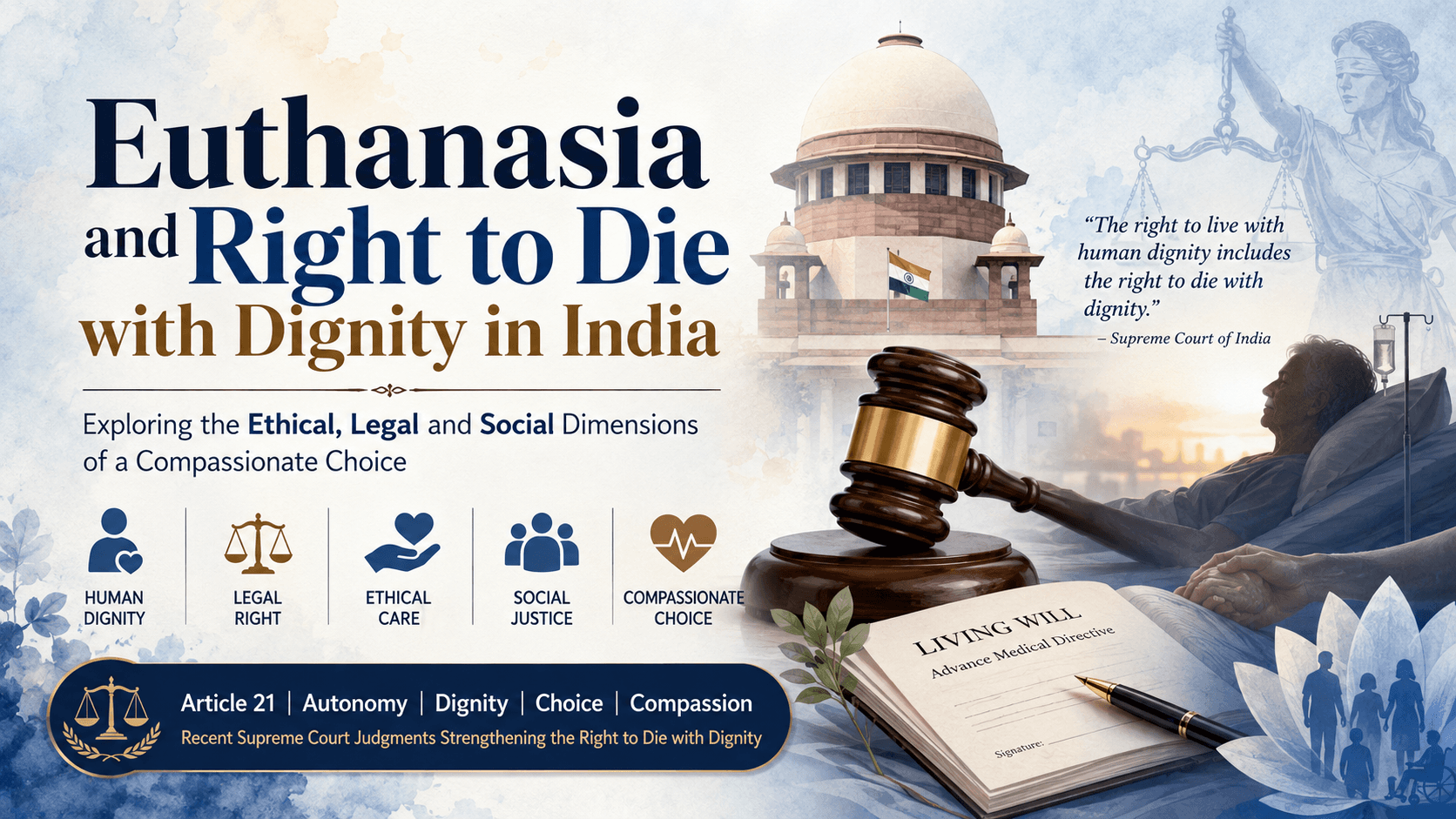
The Supreme Court's judgment in Harish Rana v. Union of India (2026) reaffirmed that the right to die with dignity forms an integral part of Article 21 of the Constitution, allowing the withdrawal of life support, including Clinically Assisted Nutrition and Hydration (CANH), under prescribed safeguards. This decision marks another milestone in India's evolving constitutional jurisprudence while reopening discussions on ethics, medical responsibility, and social justice.
Legal Evolution of Euthanasia in India
India's legal position on passive euthanasia has evolved gradually through judicial pronouncements.
Aruna Shanbaug Case (2011)
The Supreme Court recognized passive euthanasia for the first time, permitting withdrawal of life support in exceptional circumstances under strict judicial supervision.
Common Cause v. Union of India (2018)
The Court held that the right to die with dignity is a fundamental right protected under Article 21, thereby recognizing passive euthanasia and validating the concept of Living Wills (Advance Medical Directives).
Common Cause Judgment (2023)
The Court simplified procedural requirements by reducing unnecessary judicial intervention and making the execution of Living Wills more practical.
Harish Rana v. Union of India (2026)
The latest judgment further strengthened patient autonomy by:
- Allowing withdrawal of Clinically Assisted Nutrition and Hydration (CANH).
- Simplifying medical board procedures.
- Reducing mandatory judicial oversight.
- Giving greater recognition to Advance Medical Directives.
This reflects India's transition towards a patient-centric and rights-based legal framework.
Ethical Dimensions
Euthanasia involves complex ethical dilemmas where competing moral principles must be carefully balanced.
1. Autonomy
Every individual has the right to make informed decisions regarding their own body and medical treatment. Respecting patient autonomy recognizes personal dignity and freedom of choice.
2. Beneficence
Healthcare professionals are expected to act in the best interests of patients by relieving pain, reducing suffering, and ensuring compassionate care.
3. Non-Maleficence
The principle of "Do No Harm" requires doctors to avoid unnecessary suffering. Continuing futile medical treatment may itself become a form of harm.
4. Justice
Decisions regarding euthanasia must remain fair, transparent, and free from discrimination based on age, disability, economic status, or social background.
Philosophical Perspective
Theory of Double Effect
Proposed by St. Thomas Aquinas, the Theory of Double Effect states that an action may have two consequences:
- An intended positive outcome, such as relieving unbearable suffering.
- An unintended negative outcome, such as the patient's death.
The action is considered ethically acceptable if the primary intention is to relieve suffering rather than intentionally cause death.
Social Implications
Positive Outcomes
- Upholds the dignity of terminally ill patients.
- Prevents prolonged and unnecessary suffering.
- Respects individual autonomy and informed consent.
- Aligns Indian jurisprudence with modern human rights principles.
Concerns
Despite its benefits, several challenges remain:
- Possibility of coercion by family members.
- Risk of misuse against elderly or disabled individuals.
- Lack of awareness about legal safeguards.
- Unequal access to quality healthcare.
These concerns are particularly relevant in India due to socioeconomic disparities and limited healthcare infrastructure.
Economic Dimension
Long-term life support often imposes a significant financial burden on families.
Potential benefits include:
- Reduced medical expenses for terminally ill patients.
- Lower financial distress for economically weaker households.
However, economic hardship should never become the primary reason for choosing euthanasia. The law must ensure that every decision remains voluntary and informed rather than driven by poverty or lack of medical resources.
Changing Social Values
Indian society has witnessed a gradual shift in its perception of end-of-life care.
Earlier Approach
- Preservation of life at any cost.
Contemporary Approach
- Greater emphasis on quality of life, dignity, and compassionate healthcare.
This transformation reflects the movement from traditional moral perspectives toward modern constitutional values that prioritize individual rights and human dignity.
Challenges
Despite legal recognition, several issues continue to hinder effective implementation.
- Limited awareness regarding Living Wills.
- Inadequate palliative care facilities across the country.
- Need for stronger monitoring mechanisms to prevent misuse.
- Ethical dilemmas faced by healthcare professionals.
- Variations in hospital infrastructure and medical expertise.
Way Forward
A balanced framework is necessary to ensure that the right to die with dignity is exercised responsibly.
Key measures include:
- Strengthening palliative and end-of-life care services.
- Creating robust legal safeguards against misuse.
- Promoting awareness about Advance Medical Directives.
- Providing ethical training to healthcare professionals.
- Ensuring that every decision is voluntary, informed, and medically justified.
- Expanding access to affordable healthcare so that financial constraints do not influence end-of-life decisions.
Conclusion
The recognition of the right to die with dignity represents a significant milestone in India's constitutional and human rights jurisprudence. It reflects the judiciary's commitment to protecting individual autonomy while balancing ethical concerns and societal interests. However, legal recognition alone is not sufficient. Effective implementation requires strong institutional safeguards, improved palliative care, public awareness, and continuous ethical oversight. A compassionate and well-regulated framework will ensure that dignity remains at the heart of end-of-life care in India.
Mains Enrichment Keywords
- Article 21
- Right to Die with Dignity
- Passive Euthanasia
- Living Will
- Advance Medical Directive
- Patient Autonomy
- Palliative Care
- Constitutional Morality
- Human Dignity
- Ethical Dilemma
- Non-Maleficence
- Beneficence
- Vulnerable Groups
UPSC Mains Practice Question
Q. Examine the concept of the "Right to Die with Dignity" under Article 21 of the Indian Constitution. Discuss its ethical, legal, social, and economic dimensions in light of recent judicial developments.
(250 Words, 15 Marks)
What did the Supreme Court rule in Harish Rana v. Union of India (2026)?
The Court reaffirmed that the right to die with dignity is part of Article 21 and allowed withdrawal of life support, including Clinically Assisted Nutrition and Hydration (CANH), under prescribed safeguards.
Which case first recognized passive euthanasia in India, and in what year?
The Aruna Shanbaug case in 2011 was when the Supreme Court first recognized passive euthanasia, permitting withdrawal of life support in exceptional circumstances under strict judicial supervision.
What did the Common Cause v. Union of India (2018) judgment establish?
It held that the right to die with dignity is a fundamental right under Article 21 and validated Living Wills, or Advance Medical Directives.
How did the 2023 Common Cause judgment change the earlier framework?
It simplified procedural requirements by reducing unnecessary judicial intervention and making the execution of Living Wills more practical.
What four ethical principles does the article discuss in relation to euthanasia?
It discusses autonomy, beneficence, non-maleficence, and justice as the core competing ethical principles involved.
What is the Theory of Double Effect mentioned in the article?
Proposed by St. Thomas Aquinas, it holds that an action with both an intended positive outcome, such as relieving suffering, and an unintended negative outcome, such as death, can be ethically acceptable if the primary intention is relief of suffering.
What concerns does the article raise about the risk of misuse of euthanasia?
It raises the possibility of coercion by family members, risk of misuse against elderly or disabled individuals, lack of awareness of legal safeguards, and unequal access to quality healthcare.
What economic dimension of euthanasia does the article highlight?
It notes that long-term life support imposes a significant financial burden on families, though it stresses that economic hardship should never be the primary reason for choosing euthanasia.
What "way forward" measures does the article recommend?
It recommends strengthening palliative and end-of-life care, creating legal safeguards against misuse, promoting awareness of Advance Medical Directives, and ensuring every decision is voluntary and informed.
Is this topic part of the BPSC/UPSC syllabus?
Yes, this falls under Ethics & GS4, dealing with ethical dilemmas, case studies, and the constitutional dimension of dignity and autonomy relevant to Mains ethics answer writing.