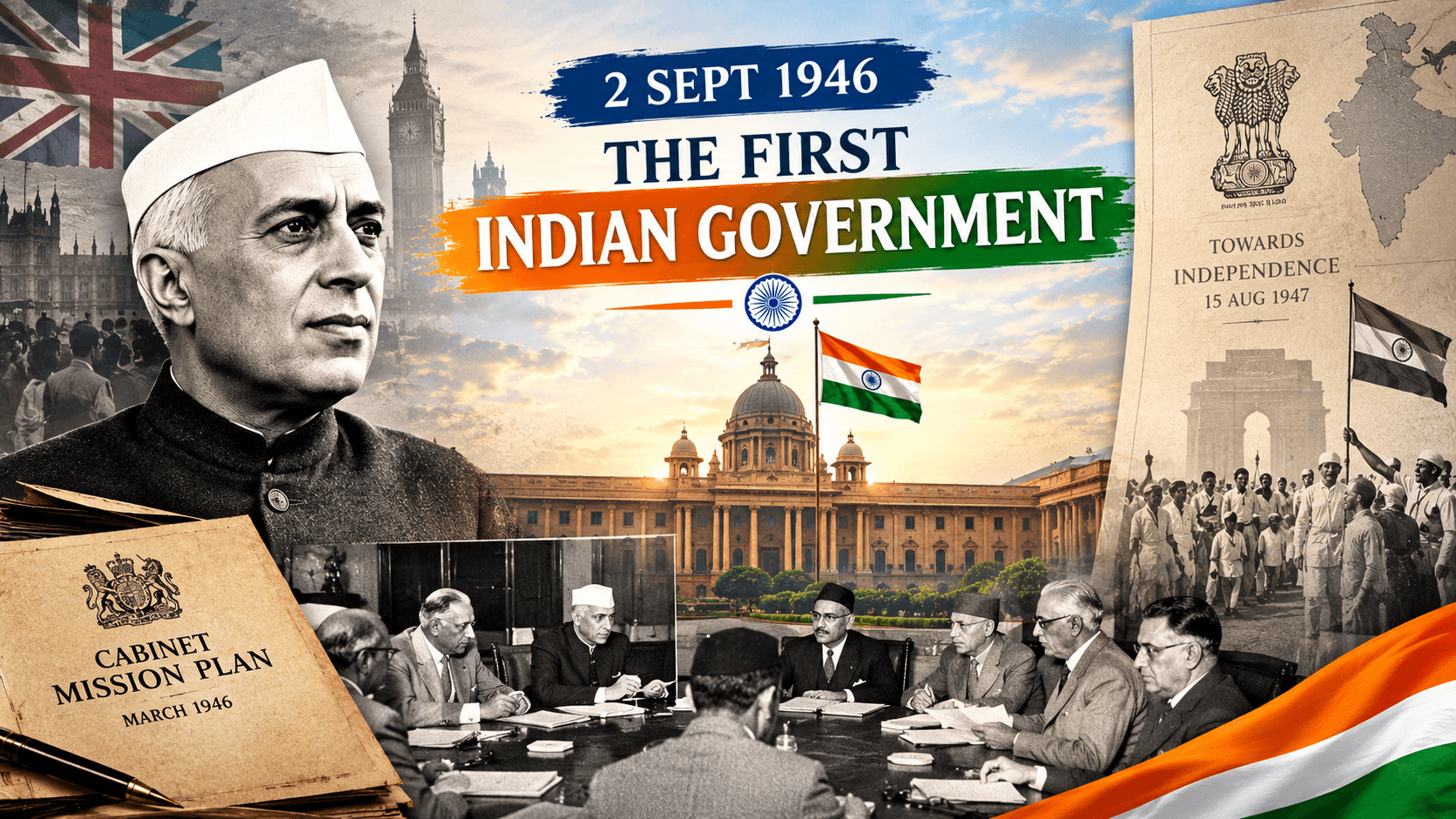
1946: The First Indian Government
Why in News?
2nd September marks the anniversary of the Interim Government of India formed in 1946, headed by Jawaharlal Nehru. It was the first time Indian leaders took charge of running British India, a decisive step towards independence on 15th August 1947.
Background: Why Britain Agreed to Leave
After World War II, Britain was exhausted. Economic collapse and uprisings like the Royal Indian Navy Mutiny of 1946 forced PM Clement Attlee to speed up the transfer of power.
| The Cabinet Mission Plan: | The Blueprint in March 1946: Britain sent the Cabinet Mission headed by Lord Pethick-Lawrence, Sir Stafford Cripps, and A.V. Alexander. |
| Key proposals: | Rejected the demand for Pakistan initially |
| Proposed a 3-tier federal structure: | Union, Section, and Province |
| Grouped provinces into three sections: | Section A (Hindu-majority), Section B (Muslim-majority), Section C (Bengal and Assam) Provided for a 389-member Constituent Assembly, the lapse of British paramountcy over princely states, and the formation of an interim government. |
What Was the Interim Government?
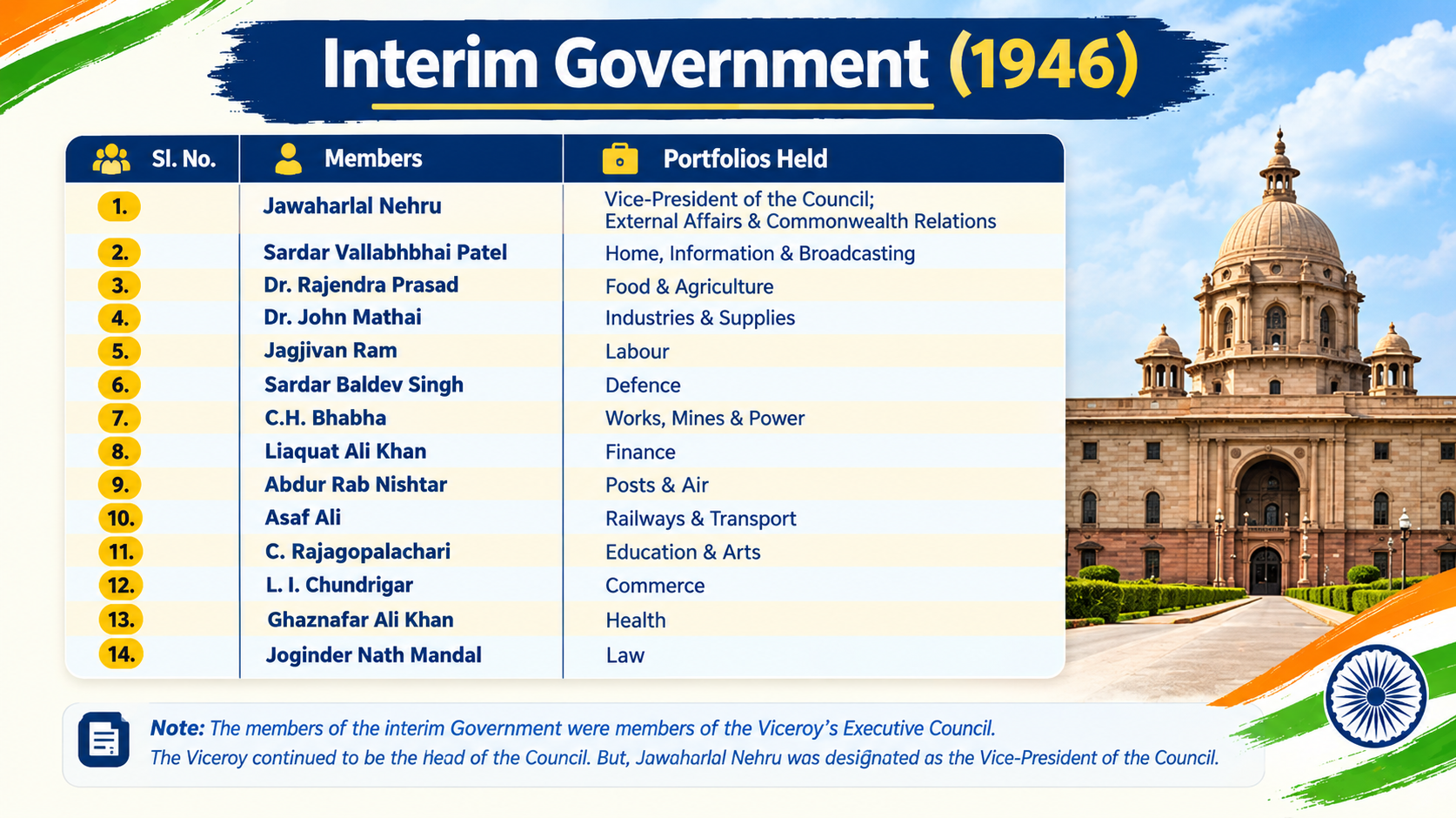
It was a provisional government to manage day-to-day administration and help in the transition to independence.
It was meant to work like a cabinet, not just as advisers to the viceroy. Its main objectives were to prepare for independence, coordinate the transfer of power, and assist the Constituent Assembly.
Legally, it still functioned under the Government of India Act, 1919, through the Viceroy's Executive Council. The viceroy remained the formal head, but real power shifted to Indians.
Who Led It?
Lord Wavell, the Viceroy, was the ex-officio President
Jawaharlal Nehru was made Vice-President of the Executive Council, effectively the de facto Prime Minister.
Direct Action Day: The Turbulent Start
Congress agreed to join, but talks failed over grouping and communal representation. The Muslim League withdrew its acceptance and called for Direct Action Day on 16th August 1946, which led to horrific riots, including the Great Calcutta Killings.
Despite this, Viceroy Wavell invited Nehru to form the government, which took office on 2nd September 1946.
Entry of Muslim League: A Government Within a Government
Realizing the boycott was isolating it, the League joined on 26th October 1946, without accepting the Cabinet Mission Plan or giving up Direct Action. Three Congress members resigned to make space for five League nominees.
Liaquat Ali Khan became a finance member and used his powers to block many Congress initiatives, making the interim government a house divided even before independence.
Significance of the Interim Government:
| Independent Foreign Policy: | Nehru laid the foundations for non-alignment and independent diplomacy, asserting India's separate voice in world affairs even before formal independence. |
| Princely States: | Addressed relations with princely states and laid groundwork for their future integration into the Indian Union, with a coordinated mechanism considered necessary during transition. |
| Indianization of Administration: | Began transferring control of civil services, police, and armed forces to Indian leaders, moving real administrative power from British to Indian hands. |
| Governing Experience: | Indian leaders gained first-hand experience in administration, food management, and developmental planning, which proved crucial after independence. |
| Realization of Inevitability of Partition: | The constant paralysis and internal blocking within the interim government, especially after the Muslim League's entry, convinced leaders like Sardar Patel and Nehru that an unworkable coalition at the center would lead to continuous civil strife. This experience paved the way for the acceptance of Lord Mountbatten's Partition Plan of 3rd June 1947. |
Conclusion
The Interim Government of 1946 was more than a caretaker arrangement. It was India's first real experiment in self-rule. For the first time, Indians ran the departments, drafted foreign policy, dealt with food crises, and negotiated with princely states. At the same time, its internal deadlock exposed the impossibility of a united Centre with the Muslim League. That experience taught two lasting lessons, that India needed administrative Indianization and strong institutions, and that partition had become unavoidable to ensure a workable government. In many ways, the government that took charge on 2nd September 1946 was the bridge between colonial rule and the independent republic born on 15th August 1947.