
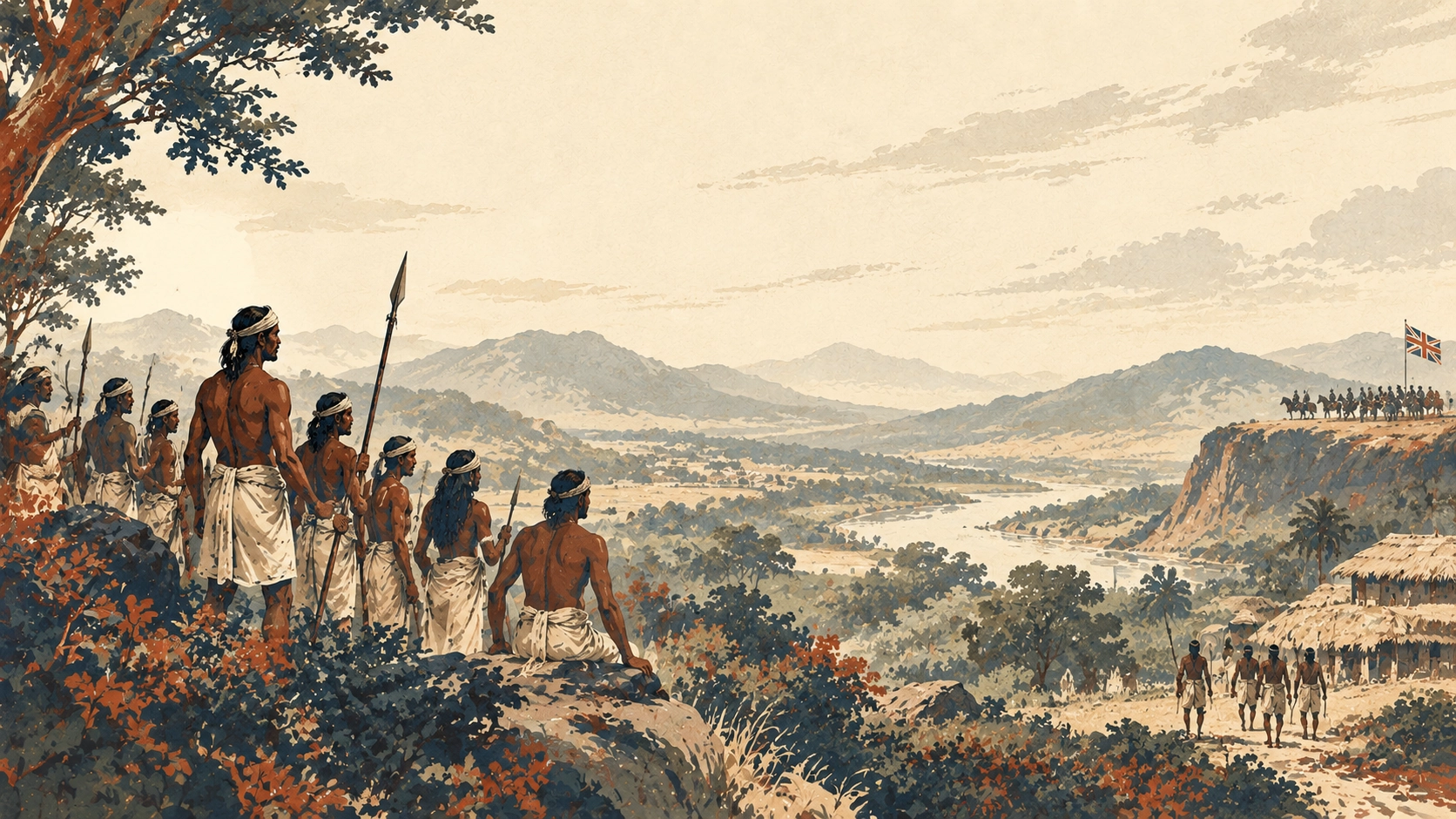
1776Chuar uprisings
An early uprising against expanding colonial authority.
Modern Indian History · BPSC GS-1
A concise study of the pressures behind tribal resistance, the Santhal Hul and Birsa Munda's Ulgulan-and the changes their struggles left behind.
An early uprising against expanding colonial authority.
Kols in different regions rose against local oppression.
An armed revolt against dikus, zamindars and Company rule.
Birsa Munda joined religious reform with a call for Munda Raj.
Roots of resistance
As colonial rule expanded into tribal regions, revenue systems and outsiders threatened political autonomy, customary landholding and control of local resources.
In many communities, land and resources had been governed through customary and collective rights. Colonial revenue systems, individual assessments and zamindari-tenancy claims weakened community control and disrupted political and cultural autonomy.
Dikus-outsiders such as moneylenders, traders, zamindars, thikadars and mahajans-drew cultivators into debt through loans and exploitative interest. Unpaid balances, compound interest and revenue arrears led to land alienation and bonded labour.
Forest, land and other colonial regulations restricted customary use of forests and wastelands. For communities whose livelihood and culture depended on local resources, these laws were encroachments on natural rights.
Forced labour (begar or beth-begari), extortion by police, revenue officials and courts, physical abuse, crop and cattle seizures, unpaid work, and assaults on women deepened discontent.
The arrival of outsiders, missionary activity and the loss of customary authority threatened community identity, dignity, social relations and religious practices as well as livelihoods.
Patterns across movements
These movements were locally organised public protests, rooted in community ties and grievances, often seeking to restore customary rights and social order.
Movements mobilised people across age groups through local leadership, kinship and ethnic solidarity. The Santhal and Munda uprisings involved mass participation, including women; Mundas, Oraons and Kharias also joined the Munda movement.
Movements grew from local grievances, leadership and ethnic boundaries, and generally did not become pan-Indian. The Santhal struggle centred on a community fatherland, while Kol uprisings could connect groups across regional boundaries.
Although colonial accounts often treated these uprisings as law-and-order problems, public assemblies, marches, advance warnings and organised action reflected an awareness of power and a determination to challenge authority. Rebels identified oppressors-zamindars, moneylenders and officials-and potential allies among peasants and lower classes.
Violent resistance used bows, arrows, swords and spears against colonial forces with modern firearms, trained troops and greater capacity to organise repression.
Leadership, organisation, programme and ideology generally emerged within the communities themselves. Many movements aimed to restore customary rights and an imagined earlier social order rather than propose a new society.
Religious belief gave legitimacy and solidarity to protest. Santhals invoked Thakur; Birsa's healing reputation and divine-messenger claims inspired followers. Messianic leadership and millenarian visions promised a return from kalyug to Satyug or a Santhal yug.
Regional examples across the colonial period
An early recorded example of tribal resistance as Company authority expanded into tribal regions and disrupted customary life.
A Chhotanagpur rising against local oppression and outsider intervention. Kol communities in different regions could mobilise simultaneously through wider ethnic ties.
A regional movement cited as an example of the local reach and locally organised character of tribal uprisings rather than a single pan-Indian campaign.
The Santhal struggle against zamindars, mahajans and Company rule became one of the fiercest episodes of popular armed resistance before 1857.
Birsa Munda's movement linked internal religious reform, land rights and the political demand to end British rule and establish Munda Raj.
1855–56 · Rajmahal hills
The rebellion confronted the combined power of zamindars, mahajans and Company authority, becoming one of the largest episodes of popular armed resistance in the region.
Santhals lived across parts of present-day Bihar, Jharkhand and Bengal, including Barabhum, Chhotanagpur, Purulia, Palamau, Hazaribagh, Dumka, Bankura and Birbhum. After Permanent Settlement and new land claims, many retreated to the Rajmahal Hills, cleared the forest and settled Damin-i-koh (Santhal Pargana).
A new revenue system assessed each cultivator individually and reportedly tripled the burden. Zamindars, police, revenue offices and courts extracted taxes and levies; moneylenders used high and compound interest, took land and imposed bonded labour. Abuse by railway workers and local agents added to the grievances. A false theft charge and a policeman's confrontation triggered the rising.
On 30 June 1855, about 6,000 representatives from 400 villages gathered at Bhagwadih. Sidhu and Kanhu Murmu led the rising, with their brothers Chand and Bhairav. They resolved to resist the dikus and Company authority and establish justice and dharma.
When their ultimatum went unanswered, thousands armed with bows and arrows rose against the zamindars, mahajans and government. They attacked moneylenders, zamindars, planters, railway engineers and officials, disrupted post and rail links between Bhagalpur and Rajmahal, and proclaimed Santhal rule. Lower-caste non-tribal peasants also assisted them.
Santhal archers initially used guerrilla tactics effectively. The Company deployed modern firearms, martial law and brutal counter-insurgency; villages were burnt and leaders captured. Estimates in historical accounts put deaths in the many thousands. Sidhu was captured and killed in 1856; the rising was suppressed by early 1856.
The Santal Parganas Tenancy Act, 1856, and a separate Santhal Parganas administrative unit followed. Special status recognised Santhal identity; land alienation was checked, regular police was withdrawn, and local administration and the Manjhi system were restored to village leadership.
1899–1900 · Chhotanagpur
The movement combined social and religious reform with resistance to land alienation, forced labour and British authority.
In Chhotanagpur, British land and forest laws undermined customary rights. The replacement of Khunt Kulti community ownership by zamindari-tenancy brought dikus-moneylenders, landlords, thikadars, traders and mahajans-who seized land through debt and revenue arrears. Beth-begari forced labour and police-backed landlord power deepened dispossession.
Born in 1875 in Khunti, Birsa studied at a German mission school at Chaibasa before leaving the mission community. Influenced by Vaishnav traditions, he taught worship of one God, Singbonga, self-improvement, morality and cultural self-respect. He urged people to reject witchcraft, irrational rituals and alcohol; the Birsait faith offered a simple alternative to missionary authority and taxes.
Munda land alienation and diku entry had stirred agitation in 1890–95; by 1895 Birsa had a committed following among Mundas and Oraons. The movement acquired agrarian and political aims: he challenged British authority, urged refusal to pay revenue, mobilised village to village and organised separate units for armed struggle and propaganda. After imprisonment, his release in 1898 was followed by underground meetings and renewed organising.
On Christmas Eve 1899, Birsa called for Munda Raj and an end to Victorian rule. His pilgrimage to Munda sacred places became an occasion for public meetings and a promise to replace kalyug with satyug. Clashes spread through Ranchi, Khunti, Tamar, Sarwada and Bandgaon. Armed with bows and poisoned arrows, rebels attacked symbols of colonial authority; Birsaits distinguished British rule as the enemy, not Christian Mundas. The army responded with overwhelming force.
Birsa was recaptured on 13 February 1900 and died of cholera in jail on 9 June, aged about 25; the movement ended, but its political consciousness endured. Known as Dharti Abba (Father of the Earth), he became a symbol of anti-feudal and anti-colonial resistance.
Limits and consequences
Though localised uprisings were ultimately suppressed, they helped bring changes to tribal administration and land protection.
Takeaway: Although suppressed and often local in reach, tribal revolts kept alive a tradition of resistance and compelled changes in tribal administration and land protection. The Santhal Hul in particular exposed the economic exploitation at the heart of colonial agrarian relations, while the Ulgulan widened political awareness beyond immediate local grievances.
Prepare to write
Practice connecting causes, movement characteristics and consequences in a concise, evidence-led answer.