
EDU TERIA Logo
CartSign InSign UpEnroll Now
Back Science & Technology
BPSC Mains GS-2 Masterclass · Science & Technology

Smart Cities & Urban ProblemsSensors, Data & Cleaner, Safer Streets

Indian cities are choking on garbage, potholes and traffic. This page explains what makes a city 'smart', what an ideal smart city should look like, and how sensors, satellites, data and robots can clean up waste, fix roads and untangle traffic, with Bihar's own progress.

Mission100Smart cities

in the Mission at the start.

Funding₹1,000 crPer city SPV

₹500 crore each from Centre and state.

Bihar4Bihar's smart cities

Patna, Muzaffarpur, Bhagalpur, Biharsharif.

Waste75%Garbage dumped

without processing.

Roads1,604Killed by broken roads

mainly potholes, in 2018.

Bihar roads4,359.99 kmDouble-lane roads, Bihar

up from 160.61 km in 2005.

Part 1 · Smart cities

What Makes a City Smart

A smart city uses sensors and data to run its services better; India's Smart Cities Mission is building model areas in 100 cities, four of them in Bihar.

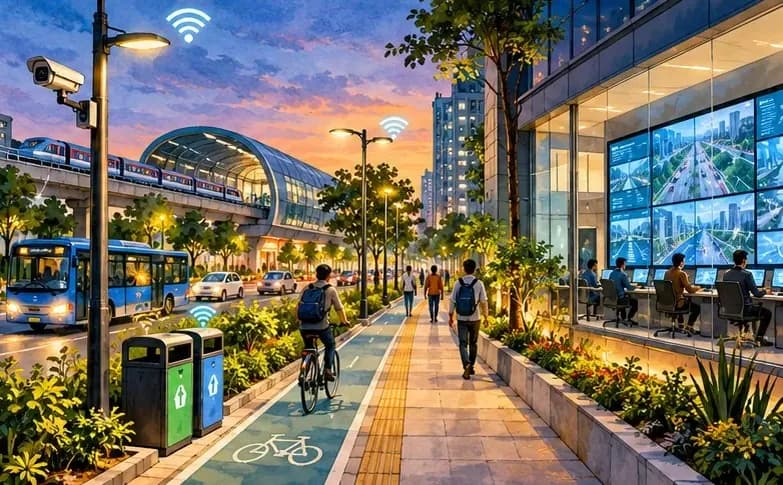
Illustration of an Indian smart city with sensor-equipped streetlights, a metro line, a control centre screen and clean, green streets

Smart cities

  • A smart city is an urban area that uses different types of electronic Internet of things (IoT) sensors to collect data and then use insights gained from that data to manage assets, resources and services efficiently, in return using that data to better improve the operations across the city.
    • This includes data collected from citizens, devices, buildings and assets that is processed and analyzed to monitor and manage traffic and transportation systems, power plants, utilities, water supply networks, waste management, crime detection, information systems, schools, libraries, hospitals, and other community services.

    Example: A smart water meter that reports a sudden jump in flow at 3 a.m. tells the city there is a leak on that street before anyone complains. The same idea applies to bins that report when they are full or signals that see a queue forming.

  • The smart city concept integrates information and communication technology (ICT), and various physical devices connected to the IoT network to optimize the efficiency of city operations and services and connect to citizens.
  • Smart city technology allows city officials to interact directly with both community and city infrastructure and to monitor what is happening in the city and how the city is evolving.
  • ICT is used to enhance quality, performance and interactivity of urban services, to reduce costs and resource consumption and to increase contact between citizens and government.
  • However, the term itself remains unclear to its specifics and therefore, open to many interpretations.
  • Major technological, economic and environmental changes have generated increased interest in smart cities, including climate change, economic restructuring, coronavirus, the move to online retail and entertainment, ageing populations, urban population growth and pressures on public finances.

National Smart Cities Mission

National Smart Cities Mission is an urban renewal and retrofitting program by the Government of India with the mission to develop smart cities across the country, making them citizen friendly and sustainable.

  • The mission initially included 100 cities, with the deadline for completion of the projects set between 2019 and 2023.
  • Smart Cities Mission envisions developing an area within the cities in the country as model areas based on an area development plan, which is expected to have a rub-off effect on other parts of the city and nearby cities and towns.
  • Each city creates a Special Purpose Vehicle (SPV), headed by a full-time CEO, to implement the Smart Cities Mission. Centre and state government will provide ₹1,000 crore funding to the company, as equal contribution of ₹500 crore each.
Smart cities in Bihar

From Bihar, Muzaffarpur, Bhagalpur, Biharsharif and Patna have been nominated.

“ICT is used to enhance quality, performance and interactivity of urban services, to reduce costs and resource consumption and to increase contact between citizens and government.”
— BPSC Mains answer · Smart cities

Curated for BPSC, UPSC & State PCS Civil Services Aspirants | Science & Technology Master Module