
EDU TERIA Logo
CartSign InSign UpEnroll Now
BPSC Mains GS-2 Masterclass · Indian Economy

Small Industries & MSMEsThe Backbone of Jobs and Exports

About six crore small enterprises make nearly half of India's manufacturing output and exports, and employ about 11 crore people, second only to agriculture. This page explains how MSMEs are defined, why they matter, what holds them back and how the government supports them.

Scale~6 croreEnterprises

a vast network across the country.

Employment~11 croreJobs

second only to agriculture.

Output45%Of manufacturing output

and about 45% of exports.

GDP~30%Of GDP

MSMEs' contribution to the economy.

Structure99%Micro units

of all MSMEs are micro enterprises.

Law2006MSMED Act

definition revised in 2020.

Part 1 · What small industries and MSMEs are

Small Industries and the MSME Definition

What small scale industries are, how the MSMED Act defines MSMEs, and how the 2020 definition changed it.

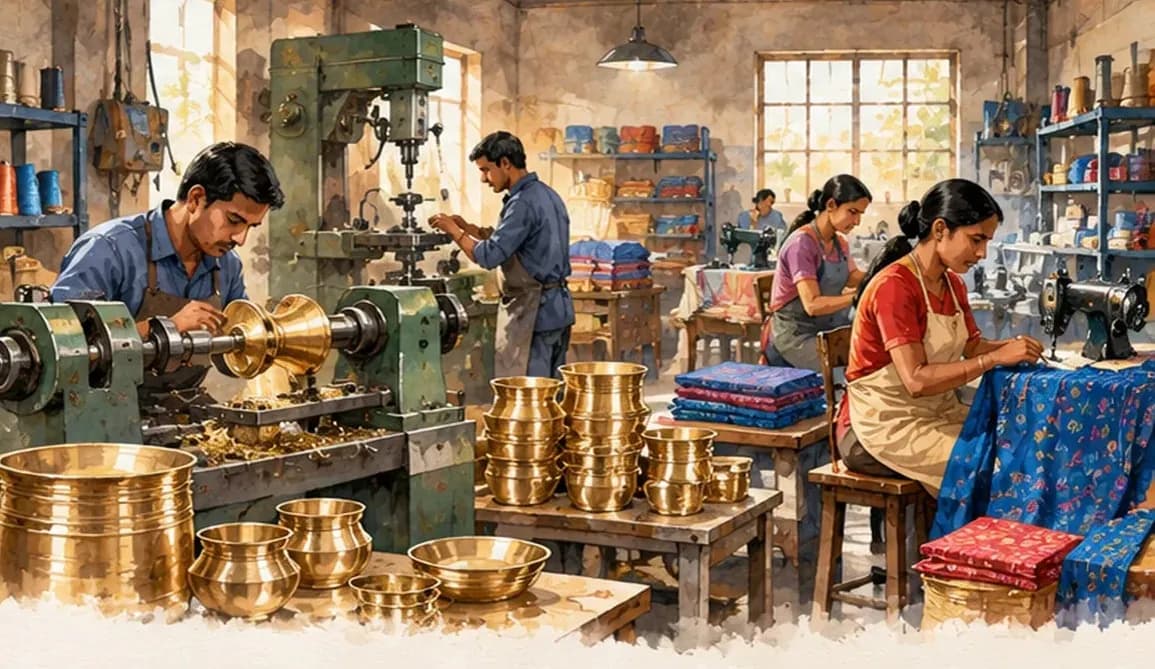
A small workshop with a few workers at simple machines making brass utensils and garments

Small scale industries

Small scale industries comprise of small enterprises that manufacture goods or provide services with the help of smaller machines and a few workers and employees. These industries are labour intensive yet require little capital.

The enterprise must fall under the guidelines set by the Government of India.

MSMEs and the new definition

MSMEs, introduced by the Government via Micro, Small & Medium Enterprises Development (MSMED) Act, 2006, are entities engaged in the production, manufacturing, processing or preservation of goods and commodities.

Last year (in 2020) government has revised the MSME definition. The changes in the definition of micro, small, and medium-sized enterprises were made as a part of the Atmanirbhar Bharat Abhiyaan relief package. Earlier, the MSMEs were defined on the basis of investments put in, now the revised definitions will also include turnover of the company.

Previous definition · Criteria: investment in plant & machinery or equipment

ClassificationMicroSmallMedium
Manufacturing enterprisesInvestment < Rs. 25 lakhInvestment < Rs. 5 croreInvestment < Rs. 10 crore
Services enterprisesInvestment < Rs. 10 lakhInvestment < Rs. 2 croreInvestment < Rs. 5 crore

Source: MSMED Act, 2006. (The 'Medium' column is cut off in the source document's table image and is filled in from the Act.)

New definition · Composite criteria: investment and annual turnover

ClassificationMicroSmallMedium
Manufacturing & ServicesInvestment < Rs. 1 cr. and Turnover < Rs. 5 cr.Investment < Rs. 10 cr. and Turnover < Rs. 50 cr.Investment < Rs. 20 cr. and Turnover < Rs. 100 cr.

As given in the source (May 2020 announcement). See the guide for the later revisions of the 'Medium' limits and the 2025 revision.

Changes in the new definition

  • Artificial separation between manufacturing and service MSMEs has been removed.
  • Investment criteria for such enterprises have been revised upwards, while an additional criterion of turnover has been introduced.
  • The definition being changed is done in the favour of MSMEs. It is expected to give them the confidence to grow.
    • There has always been this fear, among successful MSMEs also, that if they outgrow the size of what has been defined as an MSME, they will lose their entitled benefits. This is why MSMEs like to remain within the definition rather than grow. With the revised definitions of MSMEs, they will not have to worry about growing their size and can still avail benefits.

    Example: A garment unit with Rs 4 crore of machines was 'small' under the old rule and would lose its MSME benefits by buying one more machine; under the new rule it can grow to Rs 10 crore of investment and still be 'small'.

  • This new definition covers almost 99 per cent of all firms enabling MSMEs to grow in size and create jobs.
  • No incremental tax obligation ⇒ No fear of losing MSME benefits ⇒ Economies of scale ⇒ Job creation ⇒ productivity gain.

“The development of MSMEs is crucial on many counts for Indian economy and society.”
— BPSC Mains answer, 2001

Curated for BPSC, UPSC & State PCS Civil Services Aspirants | Indian Economy Master Module