

EDU TERIA Logo
CartSign InSign UpEnroll Now
Back Science & Technology
BPSC Mains GS-2 Masterclass · Science & Technology

Science for India's Four Big ChallengesPopulation, Health, Resources & Farmland

Four problems shape India's future: a huge and growing population, serious health risks, degraded land, water and air, and shrinking farms. For each, this page sets out the scale of the problem and the scientific initiatives that can answer it.

People1.37 bnPopulation

expected 1.64 bn by 2050.

Health1:1456Doctor–population ratio

WHO norm 1:1000.

Costs~60%Out-of-pocket spend

of current health expenditure.

Land29%Land degraded

ISRO, 2011-13.

Farms1.08 haAverage farm size

down from 2.28 ha in 1970-71.

Holdings86.21%Small and marginal holdings

of all holdings, 2015-16.

Part 1 · Increasing population

A Growing Population, and Science to Manage It

India has much to show since independence, but a population heading for 1.64 billion lies at the root of many other problems.

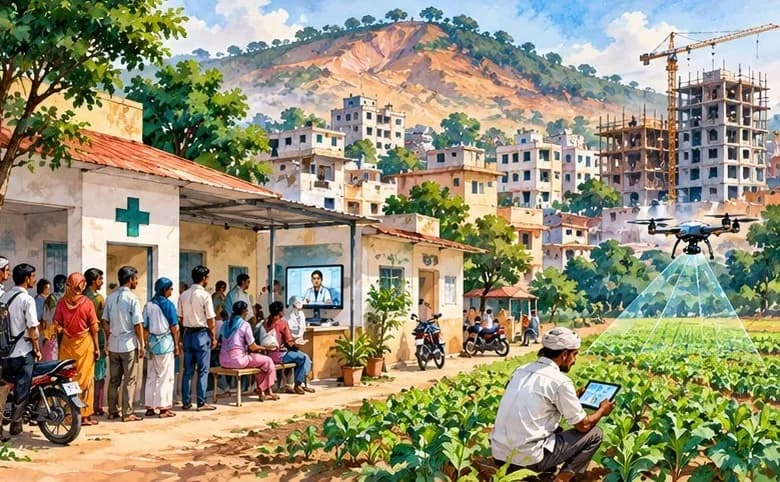
Illustration of a crowded Indian town with a health centre, a small farm plot squeezed by new buildings and a degraded hillside

Achievements and challenges

Since independence India has several achievements to its credit. It is among the fastest growing economies in the world, continued to have distinguished position of being largest democracy in the world, lifted millions out of poverty, has become a space, nuclear power as well as IT super power and enjoys a respectable image at the global level.

However, it is faced with numerous challenges like high poverty ratio, climate change, land degradation, low agricultural productivity, pollution etc. But the key issues that make our future uncertain are increasing population, higher health risks, degraded natural resources and dwindling farm lands.

Increasing population

  • According to the UN's World Population Prospects 2019 report, India is projected to become the most populous country by 2027 surpassing China.
  • The current estimated population of India is 1.37 billion and it is expected to be 1.64 billion by 2050.
  • This ever increasing population of the country is considered as the root of the numerous other challenges like low quality of life, high poverty and unemployment, degradation of environment, low capital availability for development, food security etc.
  • However, according to the National Family Health Survey (NFHS)-4, as many as 23 States and Union Territories already achieved below 2.1 TFR. And the Economic Survey 2018-19 notes that India is set to witness a “sharp slowdown in population growth in the next two decades”. But, still at the current rate of growth, India's population is likely to peak by 2048 at about 1.61 billion and is a key issue for the policy makers.

Scientific initiatives for increasing population

  • Use of Geographic information system (GIS), data-processing software, internet technologies can be used to enhance the quality and cost-effectiveness of the whole census operation, data collection and information dissemination of the data. Accurate and quality data can help the evidence based decision making regarding population control.
  • The science can also help in population control measures, e.g. using digital media platforms for spreading awareness regarding family planning, use of contraceptive technologies to ensure that every pregnancy is intended and as safe as possible.
  • Science and technology also helps addressing the issues arising due to population increase, e.g. use of internet technologies for affordability and accessibility of quality education and health services, using clean energy technologies (e.g. solar, wind, nuclear etc.) to fulfil the rising energy demands due to increasing population and economic development and using modern agricultural technologies to ensure food security.
  • The skill development technology initiatives like virtual training can help increase the human capital and demographic burden can be turned into a demographic dividend, e.g. an initiative for capacity building through Virtual learning modules namely iGOT platform.
“If India is to attain the sustainable development goals, these key challenges must be addressed. And science and technologies are important tools which will help us in this process.”
— BPSC Mains answer · National challenges

Curated for BPSC, UPSC & State PCS Civil Services Aspirants | Science & Technology Master Module