

EDU TERIA Logo
CartSign InSign UpEnroll Now
BPSC Mains GS-2 Masterclass · Indian Polity

The President of IndiaAll the Authority, Little of the Power

Every power the Constitution gives the President, why he must act on his ministers’ advice, where he can still make a difference, and how an electoral college of MPs and MLAs chooses him.

PowerArticle 53Executive power

Vested in the President, in name.

LimitArticle 74Aid & advice

Exercised on the advice of ministers.

Eligibility35 yearsMinimum age

Plus citizenship and Lok Sabha eligibility.

Nomination50 + 50Proposers & seconders

With a Rs 15,000 deposit in the RBI.

MethodSTVSingle transferable vote

Proportional representation, secret ballot.

Tenure5 yearsTerm of office

Election disputes go to the Supreme Court.

Seven roles, one office

The Powers of the President

India has a parliamentary form of government. So the President is only the nominal executive; the real executive is the council of ministers headed by the Prime Minister. Yet on paper, the President holds a remarkable range of powers.

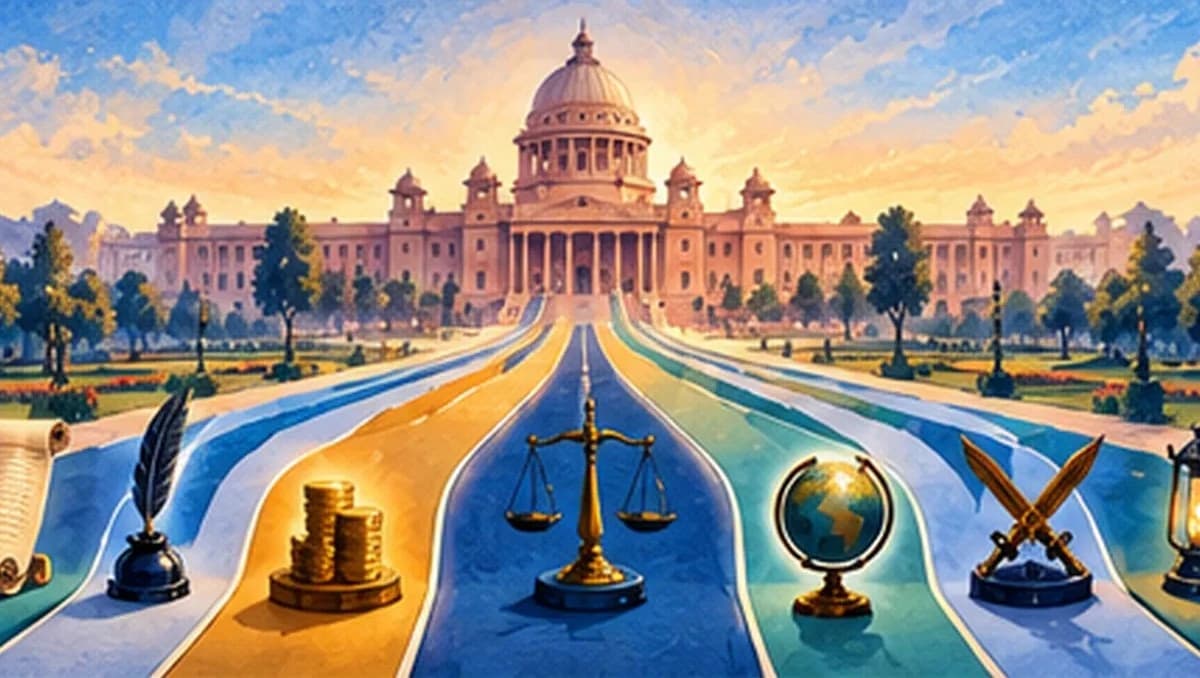
A grand domed presidential palace at dawn, with seven ceremonial paths leading up to its steps
The executive role

All executive actions of the Government of India are formally taken in the President’s name.

Art 53
  • Under Article 53, the executive power of the Union is vested in the President, to be exercised directly or through subordinate officers, in accordance with the Constitution.
  • Makes rules on how orders and other instruments made and executed in his name are to be authenticated.
  • Appoints the Prime Minister and the other ministers, who hold office during his pleasure.
  • Appoints the Attorney General of India (and fixes his pay), the Comptroller and Auditor General, the Chief Election Commissioner and other Election Commissioners, the Chairman and members of the UPSC, state Governors, the Chairman and members of the Finance Commission, and others.
  • Can seek any information on the administration of the Union, and proposals for legislation, from the Prime Minister.
  • Can require the Prime Minister to place before the council of ministers any matter on which a minister has decided but the council has not considered.
  • Can appoint a commission to investigate the conditions of SCs, STs and other backward classes.
  • Can appoint an Inter-State Council to promote Centre–state and inter-state cooperation.
  • Directly administers the Union Territories through administrators he appoints.
  • Can declare any area a Scheduled Area, and has powers over the administration of Scheduled Areas and tribal areas.
“He represents the nation but does not rule the nation.”
— Dr. B.R. Ambedkar, on the President of India

Curated for BPSC, UPSC & State PCS Civil Services Aspirants | Indian Polity Master Module