

With about 2,700 registered parties in all, India has the largest number of political parties in the world. It has all categories of parties — left, centrist, right, communal, non-communal and so on.
BackBack to Beyond the Book Indian Polity · Bihar
BPSC Mains GS-2 Masterclass · Indian Polity
Political Parties & Pressure GroupsPersonalities, Promises and Pressure
Why India’s party system is called individualistic rather than nationalistic, whether Bihar votes on development or on identity, and how organised pressure groups shape law, policy and public opinion.
 Parties~2,700Registered parties
The most of any country in the world.
 TrendSince 1989Coalition era
Regional parties fill the Congress vacuum.
 Bihar206 / 243Bihar, 2010
JD(U)–BJP sweep under the NDA.
 Development40%+Of GSDP
Bihar’s development, social and capital spending (2013-14).
 Pressure11 kindsPressure groups
From business lobbies to anomic groups.
 Role‘Safety valve’Role of pressure groups
For individual and collective grievances.
What is a party system?
India’s Multi-Party System — and Bihar’s
The meaning of a party system relates to the number of political parties in a country and the pattern of interaction and competition between them. In India, this pattern has given way to a multi-party system. Bihar also has the same type of party system.
~2,700Registered political parties
Every category of party
LeftCentristRightCommunalNon-communal…and so on
Since 1989, there has been a definite increase in the number of political parties entering the political arena. Numerous regional and small parties have filled the vacuum created by the Congress.
Till 2014, before the surge of another national party, the BJP, the strength of the major national parties had been decreasing and that of the smaller parties increasing.
The system of Indian political parties
Why the Party System Is Called ‘Not Nationalistic’
Six features of Indian party politics — from vague ideologies and caste-based parties to defections and a divided opposition — that pull it away from a national outlook.
Lack of clear ideology
- Except the BJP and the two communist parties (CPI and CPM), no party has a clear-cut ideology. All the others are ideologically close to each other and closely resemble each other in their policies and programmes.
- More than this, every party — including the so-called ideological parties — is guided mainly by one consideration: capturing power.
- Accepting a common programme does not mean alliance partners share a common ideology; ideological cohesion does not characterise alliances.
- E.g. in Bihar, the JD(U)’s alliance with the BJP is not based on a common ideology.
Personality cult
Why the Party System Is ‘Individualistic’
Personality cult: quite often, parties are organised around an eminent leader who becomes more important than the party and its ideology. Parties are known by their leaders rather than by their manifestos.
“There are political personalities rather than political parties in India.”
The leader above the party
- Mostly, an individual leader eclipses the party that is notionally responsible for victory in an election.
- Major decisions are taken by one leader, and his decisions remain undisputed within the party.
- There is also a lack of inner-party democracy.
The Bihar example
E.g. in Bihar, the RJD, JD(U), LJP, VIP, etc. are all known by their leaders.
RJD
JD(U)
LJP
VIP
Leader first, party second.
However…
The Other Side: How the Party System Also Serves the Nation
The same multi-party system mirrors India’s diversity, gives small parties a voice, and has strengthened federalism.
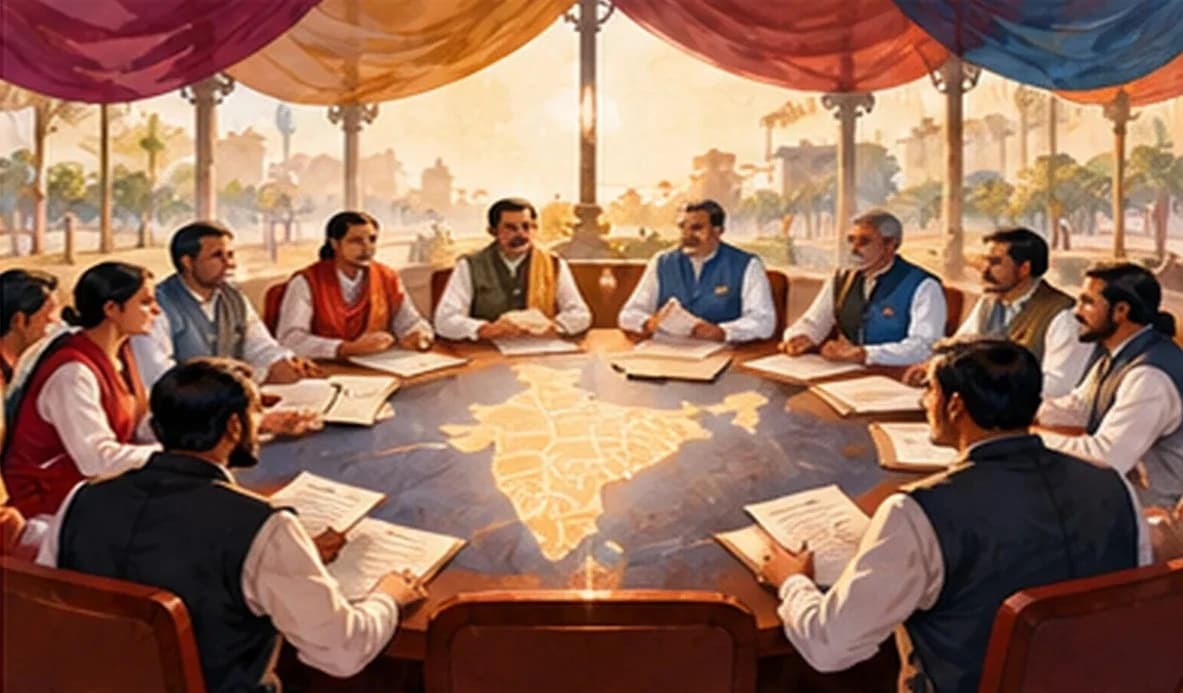
One-dominant party system
After a gap of a few decades following the decline of the Congress, the BJP has again risen to a position of hegemony.
A mirror of society
The contemporary party system reflects the complexity and heterogeneity of Indian society.
- It represents the diversity of political interests and opinions, and the wider reach of participatory politics that has politicised diverse groups and given them a political voice. It helps create more democratic political space.
- This extensive politicisation has made party politics accommodative: power politics is no longer dominated solely by big, hegemonic parties.
Small parties matter
Smaller parties carry real importance. As partners in multi-party governance, they have developed bargaining power — so they not only share power but also get a voice in political decision-making.
Shared national ideas
Almost every party advocates democracy, secularism, socialism and Gandhism — ideas inherent in Indian nationalism.
Regional parties mainstreamed
With the growth of coalition government, regional parties have been mainstreamed, and the earlier distinction between regional and national parties has blurred.
- National parties have become regional in character (e.g. the BJP planning reservation for locals in private jobs for native residents of MP and Haryana), and regional parties increasingly participate in national politics (e.g. most parties support a tough stand against Pakistan-sponsored terrorism), acquiring national stature.
- The Congress and the BJP have for a long time had a ‘regional’ rather than ‘national’ sphere of influence — e.g. the BJP’s hold is stronger over the Hindi heartland.
- With regional parties entering national politics, regional and federal issues are an important part of the national agenda. Regional assertions are no longer treated as dangerous for the nation.
- The national agenda is also more visible in state elections: border disputes and counter-terrorism issues affect campaigns and results within states.
Stronger federalism
The rise of regional parties had important implications for Indian federalism. The emerging party system has an essential element of partnership between national, regional and state-level parties.
- This gives a basis for a more egalitarian relationship between the Centre and the states; the party system itself provides the institutional set-up for representing the states’ interests.
- Greater sensitivity towards regional issues has developed, and a greater consensus on federalism has emerged.
- Even national parties that traditionally favoured a strong Centre have been forced to accept the logic of federalism.
Development vs ascriptive politics
Does Bihar Now Vote on Development?
It is not so much caste and politics but economic policy that is emerging as an important factor for parties and campaigns.
Bihar, 2010
Much has changed in Bihar’s political landscape since 2010, when the Janata Dal (United), in alliance with the BJP under the NDA banner, swept the state election, winning 206 of 243 seats.
206 of 243 seats
Since then, Bihar has seen a major reconfiguration of party alliances.
Spending on development
Nitish Kumar is widely credited with turning around Bihar’s economy and strengthening law and order. His long-lasting popularity among diverse sections of people testifies that Indian politics today primarily revolves around development politics.
When he became Chief Minister in 2005, he massively expanded state spending. The Reserve Bank of India estimates that by 2013-14 Bihar was the only state where development expenditure, social sector expenditure and capital outlay together exceeded 40% of GSDP, while the average among non-special category states was a little under 24%.
Bihar (2013-14)>40%
Non-special category states (avg.)<24%
Development + social sector expenditure + capital outlay, as a share of GSDP (RBI)
It is often wrongly assumed that voters cannot comprehend the impact of economic policy choices.
- But Bihar has a very mobile population because of labour migration across India and abroad, so people observe very different models of development and their consequences.
- While many states have urbanised rapidly in recent decades, Bihar remains the second least urbanised state in India. Joblessness, low private investment and weak urbanisation are just as visible to voters as state benefits.
For all the talk of caste and religion, economic policy is rapidly emerging as the most important axis along which parties and politicians differentiate themselves.
- In the 2014 national election, for instance, Modi came to power promising to replicate the Gujarat model across India — in contrast to the previous Congress-led government, which prioritised centrally sponsored benefits like those under MGNREGA.
Caste-based positive discrimination is also a part of social development.
The rising middle class has comparatively little interest in ascriptive ties.
Ascriptive politics
But Caste and Identity Still Count
However, ascriptive politics is still seen:
01
The Grand Alliance (JD(U), RJD and Congress) swept to power in 2015. Caste considerations are still the dominant factor behind such alliances.
02
Caste politics dominates especially in rural areas during local elections.
03
Hate speech and social media campaigns targeting particular communities are still seen.
04
Caste and religious identity are deeply ingrained in the Indian political milieu — still visible in political campaigns, ticket distribution, etc.
Core voters vs floating voters
Scholars distinguish two types of party appeals to voters:
Core voters
When one party has the numbers in its favour, the optimal strategy is to appeal to its committed core base.
Floating voters
In volatile, undecided elections with many floating voters — as in the Bihar 2015 election — the optimal strategy is to convince enough floating voters to win.
It is generally seen that the promise of vikas (development) was most attractive to floating voters.
The bigger picture
The Bihar election gives an important snapshot of larger trends in the Indian political system.
Electoral volatility is now a fundamental characteristic of Indian politics, with shifting party coalitions and changes in electoral support over the campaign.
The Indian electorate is increasingly deciding between economic policies that will shape India’s future, and much more effort is needed to understand how voters make these decisions in such a volatile environment.
Major pressure groups in Indian politics
Who Are the Pressure Groups?
Pressure groups are organisations that exert pressure on the political or administrative system of a country to extract benefits from it and advance their own interests. They act as a liaison between the government and their members; their aim is to ensure that laws or government actions favour their interests.
Legal & legitimate methods
They influence policy-making and implementation through legal and legitimate methods:
Lobbying Correspondence Publicity Propagandising Petitioning Public debating Contact with legislators
Illegitimate methods
However, sometimes they resort to illegitimate and illegal methods — strikes, violent activities and corruption — which damage the public interest and administrative integrity.
Strikes Violence Corruption
Major pressure groups in India
11 typesBusiness groups
FICCIASSOCHAMFAIFDA (Federation of All India Foodgrain Dealers Association)
Trade unions
AITUCINTUCHind Mazdoor Sabha (HMS)Bharatiya Mazdoor Sangh (BMS)
Professional groups
Indian Medical Association (IMA)Bar Council of India (BCI)AIFUCT (university and college teachers)
Agrarian groups
All India Kisan SabhaBharatiya Kisan Union
Student organisations
ABVPAISFNSUI
Religious groups
RSSVishwa Hindu Parishad (VHP)Jamaat-e-Islami
Caste groups
Harijan Sevak SanghNadar Caste Association
Linguistic groups
Tamil SanghAndhra Maha Sabha
Tribal groups
NSCN (Nagaland)Tribal National Volunteers (TNU), TripuraUnited Mizo Federal OrgTribal League of Assam
Ideology-based groups
Narmada Bachao AndolanChipko MovementWomen’s rights organisationsIndia Against Corruption
Anomic groups
Naxalite groupsJKLFULFADal Khalsa
Abbreviations in full
- FICCI
- Federation of Indian Chamber of Commerce and Industry
- ASSOCHAM
- Associated Chamber of Commerce and Industry of India
- AITUC
- All-India Trade Union Congress
- INTUC
- Indian National Trade Union Congress
- ABVP
- Akhil Bharatiya Vidyarthi Parishad
- AISF
- All India Students Federation
- NSUI
- National Students Union of India
- RSS
- Rashtriya Swayamsevak Sangh
- NSCN
- National Socialist Council of Nagaland
- JKLF
- Jammu and Kashmir Liberation Front
- ULFA
- United Liberation Front of Assam
Role in Indian politics
What Pressure Groups Do — and Where They Fall Short
Pressure groups have become a very important part of the administrative system. They pressurise the administrative and political system either to promote their interests or at least to ensure their interests are not relegated to the background. No system can function effectively without taking their viewpoint into consideration.
1
Interest articulation
They bring people’s demands and needs to the notice of decision-makers. The process by which people’s claims are crystallised and articulated is called interest articulation.
2
Political socialisation
They influence people’s orientation towards the political process, and act as vital two-way communication links between the people and the government.
3
Legislative process
They play a vital role in law-making — as structures of interest articulation, and as active agencies lobbying legislators for desired laws or amendments to laws and policies.
- From the preparation of party election manifestos to the passing of laws, pressure groups remain associated with rule-making.
4
Administration
They are actively involved in administration: by lobbying the bureaucracy, they can usually influence how policy is implemented.
5
Judicial administration
They use the judicial system to secure and safeguard their interests — approaching the courts for redress against the government, or to have a decision or policy declared unconstitutional.
6
Public opinion
They play a leading role in forming public opinion: each group continuously evaluates laws, rules, decisions and policies affecting its interests, and places the pros and cons before its members and the public to win support and catch the government’s attention.
- They seek public support through information campaigns, meetings, petitions, etc., and try to get the media to focus on their issues.
7
Better government
They improve the quality of government. Consulting affected groups is the rational way to decide in a free society; their information and advice improve the quality of policy and legislation.
8
Liberal democracy
Freely operating pressure groups are essential for liberal democracy:
- They are vital intermediary institutions between government and society.
- They assist in the dispersal of political power.
- They provide important counterweights to concentrated power.
9
New issues, social progress
They bring new concerns onto the political agenda, facilitating social progress and preventing stagnation — e.g. the women’s and environmentalist movements.
10
Safety valve
They increase social cohesion and political stability by providing a ‘safety-valve’ outlet for individual and collective grievances and demands.
11
Accountability
They complement opposition parties by exposing bad policies and wrongdoing by the government — improving decision-makers’ accountability to the electorate.
12
Information & reconciliation
They educate people, compile data and give specific information to policy-makers — an informal source of information. The constructive participation of many groups helps reconcile the general interest with individual group interests.
To conclude
Pressure groups are now considered an indispensable and helpful element of the democratic process. Society has become highly complex, and individuals cannot pursue their interests alone; they need fellow beings’ support for greater bargaining power — giving rise to pressure groups based on common interests.
Democratic politics has to be politics through consultation and negotiation, with some bargaining involved. So it is essential for the government to consult these organised groups at the time of policy formulation and implementation.

Exam preparation
BPSC Mains Previous Year Questions
Every question this page prepares you for, with the parts that answer it.
Q165th BPSC
“The system of Indian political parties is not nationalistic but it is individualistic.” Explain this fact in the context of Bihar State.
Q2BPSC (2019)
Do you agree that Indian politics today primarily revolves around development politics rather than ascriptive politics? Discuss with reference to Bihar.
Q3BPSC (2018)
Identify the major pressure groups in Indian politics and examine their role in it.
“Democratic politics has to be politics through consultation, through negotiation.”
Curated for BPSC, UPSC & State PCS Civil Services Aspirants | Indian Polity Master Module