
EDU TERIA Logo
CartSign InSign UpEnroll Now
Back Geography of India
BPSC Mains GS-2 Masterclass · Geography of India

Physical Geography of IndiaMountains, Plains, Plateau & Coasts

India has almost every kind of landform: the young Himalayas, the vast alluvial plains, one of the oldest plateaus on Earth, a desert, two coastlines and two island groups. This page divides India into its physical divisions, then explains how the Peninsula and the Himalayas were formed.

Mountains2,500 kmHimalayan length

Indus to Brahmaputra.

Plains3,200 kmNorthern Plains

east to west; 150–300 km wide.

Plateau16 lakh sq kmGreat Indian Plateau

about half of India's area.

Peak2,695 mAnaimudi

highest peak of the Peninsula.

Islands~572Andaman & Nicobar

islands/islets in the Bay of Bengal.

Tectonics~1 cm/yrHimalayan rise

as India keeps moving north.

Part 1 · The physical divisions of India

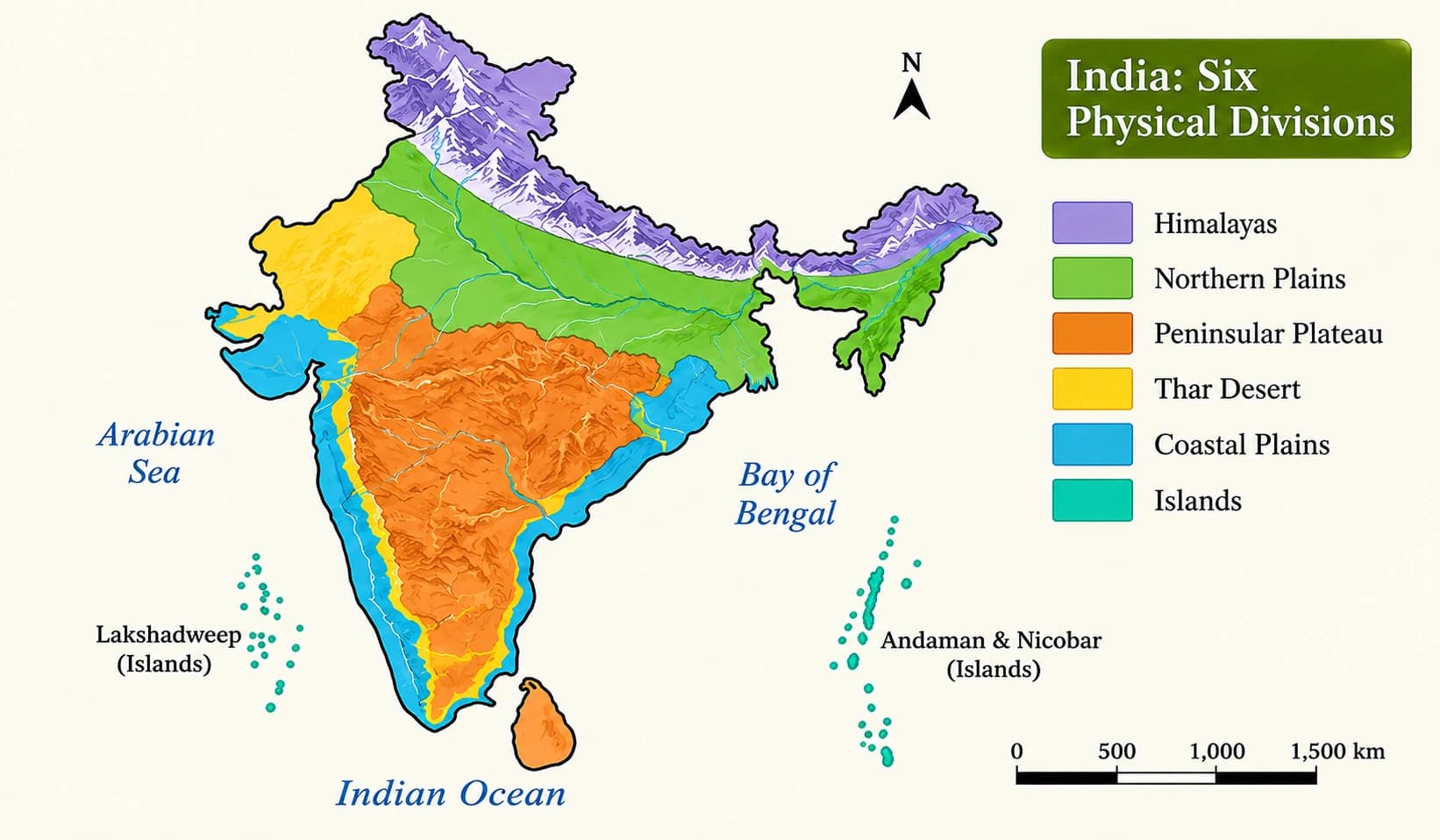
India's Six Physical Divisions

India has almost all types of physical features found anywhere in the world, grouped into six broad divisions.

Map of India showing its six physical divisions: Himalayas, Northern Plains, Peninsular Plateau, Thar Desert, coastal plains and islands

Remarkable diversity

The physical division of India has remarkable diversity. It has almost all type of physical features found anywhere in world.

Broadly, the physical divisions are northern and North-eastern mountains, the northern plains, peninsular plateau, the great Indian desert, the coastal plains and the islands.

The major physical divisions of India

Northern & North-eastern mountains

The young fold Himalayas and the Purvanchal hills.

Northern Plains

Alluvial plains of the Indus, Ganga and Brahmaputra.

Peninsular Plateau

An ancient, stable, triangular table land.

Indian Desert

The Thar, north-west of the Aravalis.

Coastal Plains

The narrow western and broad eastern plains.

Islands

Andaman & Nicobar and Lakshadweep.

About the maps

The question asks you to describe the divisions 'with maps'. In the exam, draw a simple outline map of India and mark the six divisions; small sketches of the Himalayan ranges and the plateau's sub-divisions earn extra marks.

“The Himalayas are still rising by more than 1 cm per year as India continues to move northwards into Asia.”
— BPSC Mains answer, 1993

Curated for BPSC, UPSC & State PCS Civil Services Aspirants | Geography of India Master Module
