
EDU TERIA Logo
CartSign InSign UpEnroll Now
Back Science & Technology
BPSC Mains GS-2 Masterclass · Science & Technology

Nuclear Energy in IndiaFission, Three Stages, Facts & Fears

Nuclear power splits atoms to make electricity without burning coal. This page explains how a reactor works, India's reactors and Homi Bhabha's three-stage plan to use thorium, whether nuclear power can end the power crisis, how civil and military uses are linked, and the full case for and against.

India22Reactors in operation

in 7 nuclear power plants.

Capacity6,780 MWInstalled capacity

1.9% of India's total.

Thorium~25%World thorium reserves

but only 1–2% of uranium.

Programme3 stagesBhabha's plan

PHWR, fast breeder, thorium.

History1948Atomic Energy Commission

set up; BARC named in 1967.

Bihar₹70,000 crNawada, Bihar

two reactors offered by NPCIL.

Part 1 · What is nuclear energy?

Nuclear Energy and How a Reactor Works

Nuclear power uses the heat released by splitting atoms to run steam turbines. This part explains fission, the chain reaction and the parts of a nuclear power plant.

Illustration of a nuclear power station by the sea, with a reactor dome, turbine hall and cooling tower

Nuclear energy

Nuclear power is the use of nuclear reactions that release nuclear energy to generate heat, which most frequently is then used in steam turbines to produce electricity in a nuclear power plant.

Nuclear power can be obtained from nuclear fission, nuclear decay and nuclear fusion reactions.

Presently, the vast majority of electricity from nuclear power is produced by nuclear fission of uranium and plutonium.

Nuclear power station

  • Just as many conventional thermal power stations generate electricity by harnessing the thermal energy released from burning fossil fuels, nuclear power plants convert the energy released from the nucleus of an atom via nuclear fission that takes place in a nuclear reactor.
  • When a neutron hits the nucleus of a uranium-235 or plutonium atom, it can split the nucleus into two smaller nuclei. The reaction is called nuclear fission.
  • The fission reaction releases energy and neutrons. The released neutrons can hit other uranium or plutonium nuclei, causing new fission reactions, which release more energy and more neutrons. This is called a chain reaction.

    Example: Think of a crowd of mousetraps loaded with ping-pong balls: one ball sets off a trap, which throws two more balls, which set off more traps. Control rods are like a net that catches extra balls, so the reaction runs at a steady rate instead of racing away.

  • The reaction rate is controlled by control rods that absorb excess neutrons.
    • The controllability of nuclear reactors depends on the fact that a small fraction of neutrons resulting from fission are delayed.

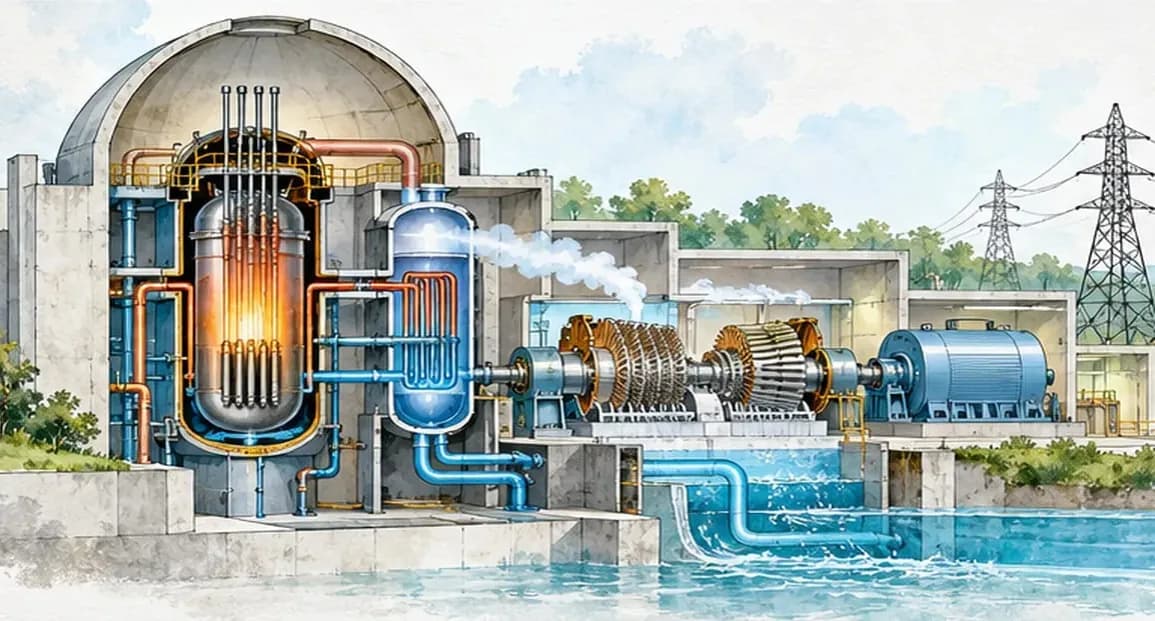
A fission nuclear power plant is generally composed of

  1. 1

    Nuclear reactor

    in which the nuclear reactions generating heat take place;

  2. 2

    Cooling system

    which removes the heat from inside the reactor;

  3. 3

    Steam turbine

    which transforms the heat into mechanical energy;

  4. 4

    Electric generator

    which transforms the mechanical energy into electrical energy.

“Nuclear energy has the potential to provide a large scale of electricity generation that itself would help lift the standard of living for millions of population.”
— BPSC Mains answer · Nuclear energy

Curated for BPSC, UPSC & State PCS Civil Services Aspirants | Science & Technology Master Module