

River water disputes
Disputes between states over sharing river water — for example, between Karnataka and Tamil Nadu over the Cauvery.
Why India is federal in form but tilted towards the Centre, what scholars and the Supreme Court make of it, how Article 356 should be read with Article 355, and why some units of the Union are more equal than others.
 IdentityArticle 1Union of States
Not a ‘federation of states’.
 Federal7 FeaturesFederal Core
Two governments, division of powers and more.
 VerdictQuasi-federalK.C. Wheare
A unitary state with subsidiary federal features.
 EmergencyArticle 356President’s Rule
Imposed more than 100 times since independence.
 Landmark1994S.R. Bommai
Federalism declared a basic feature.
 DesignAsymmetricUnequal Units
States, and UTs with or without legislatures.
Two tiers, one Constitution
The founding fathers gave India a federal structure. In a federation there are two tiers of government with clearly assigned powers and functions. The central government and the governments of the units each act within a well-defined sphere — co-ordinating with each other, yet acting independently.

Federalism is a constitutional device for bringing unity in diversity and for achieving common national goals.
The framers adopted a federal system for two main reasons — the large size of the country and its socio-cultural diversity. They realised that federalism not only ensures efficient governance but also reconciles national unity with regional autonomy.
Interestingly, the text of the Constitution does not use the word ‘federal’ or ‘federation’ anywhere.
The usual features of a federation, all present in India
Example: Amending federal provisions — such as the division of powers — also needs ratification by half the state legislatures (Article 368(2)).
Trends in the working of the Indian political system show that the states are real players, not mere agents of the Centre.
Disputes between states over sharing river water — for example, between Karnataka and Tamil Nadu over the Cauvery.
Disputes between states over territory — for example, between Assam and Mizoram, and between Maharashtra and Karnataka over Belgaum.
Creation of new states to fulfil regional aspirations — for example, Mizoram, and more recently Jharkhand.
Regional parties have emerged and come to power in states such as Andhra Pradesh and Tamil Nadu.
Differences between the states and the Centre in the GST Council.
States demand more financial grants from the Centre for their development needs.
States assert autonomy and resist interference from the Centre.
The Supreme Court has placed several procedural limits on the Centre’s use of Article 356 (President’s Rule).
Oriented towards the Centre
Yet the Indian federal structure is constitutionally oriented towards the Central Government. Alongside the federal features, the Constitution contains a large number of unitary or non-federal features.
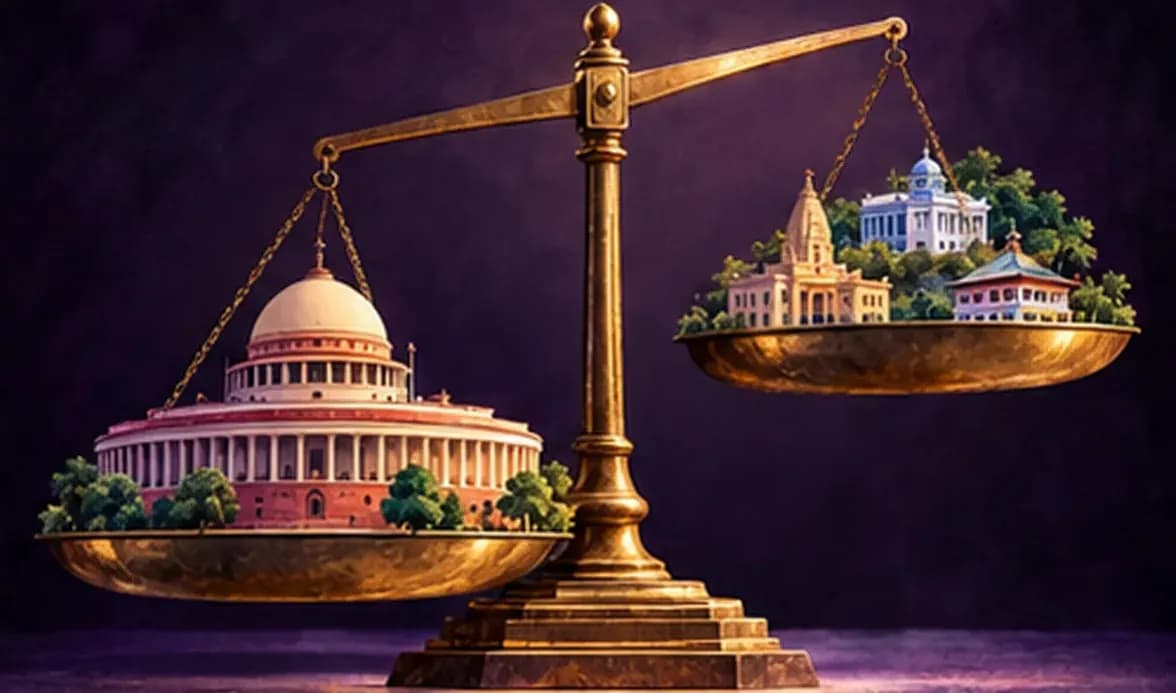
The division of powers favours the Centre and is highly unequal from a federal angle.
Compare: In the USA there is no Concurrent List: the Constitution lists the federal government’s powers and leaves everything else to the states — so residuary powers lie with the states.
Article 1 calls India a ‘Union of States’, not a ‘Federation of States’. According to Dr. Ambedkar, this shows two things:
Under Articles 2, 3 and 4, Parliament can form new states and change the area, boundaries or names of existing states by an ordinary law passed by simple majority — no special majority and no consent of the states is needed.
Example: In 2019 the State of Jammu and Kashmir was converted into Union Territories.
Unlike truly federal countries, India’s Constitution contains the constitutions of both the Centre and the states. Both must work within this single frame.
Amendment is less rigid than in other federations — most of the Constitution can be amended by Parliament alone, by simple or special majority.
Compare: In the USA, states can also propose amendments to the Constitution.
Equality of the units is not guaranteed: states do not have equal seats in the upper house.
Compare: In the USA, every state, whatever its size or population, sends two members to the Senate.
During an emergency (Articles 352–354), the Centre becomes all-powerful and the states come under its total control. The federal structure turns unitary without any formal amendment of the Constitution — something not found in any other federation.
Under Article 249, Parliament can make laws on subjects in the State List.
Example: This needs a Rajya Sabha resolution, passed by a two-thirds majority, declaring it necessary in the national interest.
There is only Indian citizenship — no separate state citizenship.
Compare: Federations such as the USA, Switzerland and Australia have dual citizenship.
The Governor, the head of the state, is appointed by the President and also acts as the Centre’s agent. Through the Governor, the Centre controls the states.
The Governor can reserve certain bills passed by the state legislature for the President’s consideration, and the President has an absolute veto over them.
A single system of courts enforces both central and state laws.
Compare: The USA has a double system: federal courts enforce federal laws and state courts enforce state laws.
All-India services are common to the Centre and the states. Their members are recruited and trained by the Centre, which also has ultimate control over them.
Example: IAS, IPS and the Indian Forest Service.
All important appointments, such as the Chief Election Commissioner and the Comptroller and Auditor-General, are made by the Union Government.
If there are disturbances in a state or any part of it, the Union can deploy central forces there.
The Planning Commission, NITI Aayog, the NIA, centrally sponsored schemes and central grants have all increased the Centre’s control over the states.
States have limited power to raise their own resources and depend a great deal on the Centre for financial help.
Laws on Fundamental Rights can be made only by Parliament, not by state legislatures.
Clearly, the Constitution tilts in favour of the Centre at the cost of the states. This has led constitutional experts to question the federal character of the Indian Constitution. The ‘strong Centre’ model was borrowed from the Canadian Constitution.
Quasi-federal, cooperative or extremely federal?
The reasons for this unique unitary–federal mix lie in India’s constitutional history, the sheer size of the country, and its complex diversities of religion, language, region and culture.
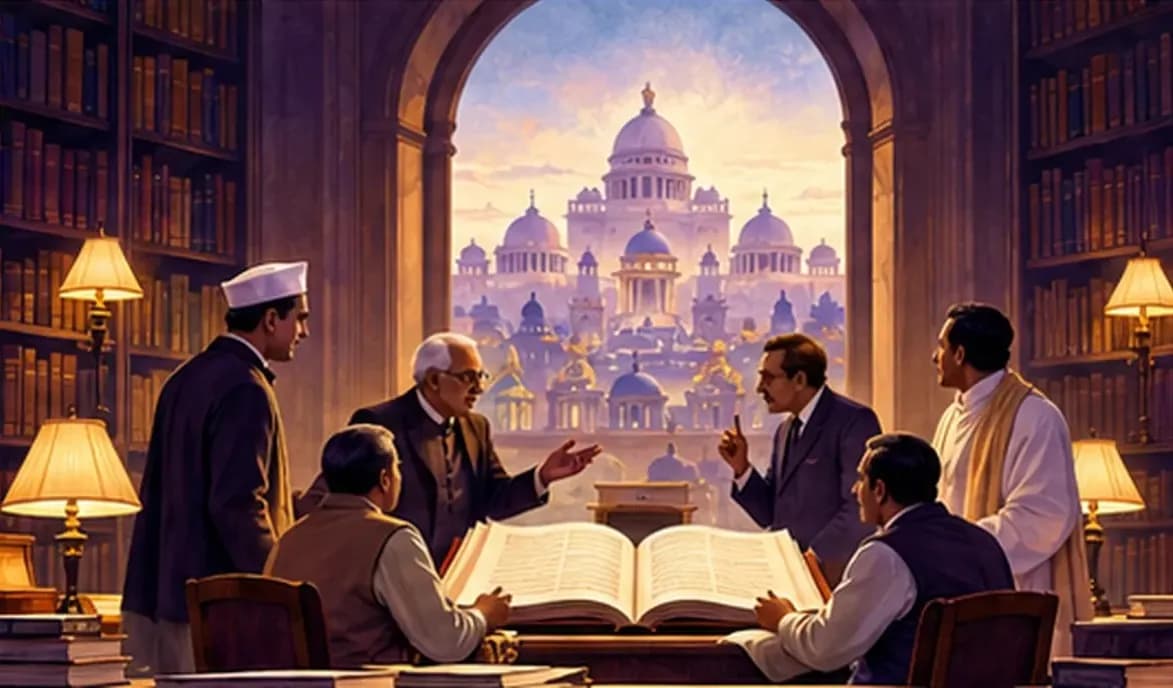
Placement is a study aid showing how far each view leans, not an exact score.
He described the Constitution as ‘quasi-federal’ — it has features of both unitary and federal government, heavily tilted towards the unitary.
“Indian Union is a unitary state with subsidiary federal features rather than a federal state with subsidiary unitary features.”
A federation, but with a strong pull towards the Centre.
“The Indian Constitution is mainly federal with unique safeguards for enforcing national unity and growth.”
The Centre is strong, but the states are not weak and have not been reduced to administrative agents carrying out the Centre’s policies.
The Centre and the states constantly bargain with each other.
He disagreed with the ‘unitary’ reading and called the Indian system extremely federal.
“The Constitution avoids the tight mould of federalism and could be both unitary as well as federal according to the requirements of time and circumstances.”— Dr. B.R. Ambedkar
“The basic principle of federalism is that the legislative and executive authority is partitioned between the Centre and the states not by any law to be made by the Centre but by the Constitution itself. This is what the Constitution does. The states are in no way dependent upon the Centre for their legislative or executive authority.”— Dr. B.R. Ambedkar
The Supreme Court has variously described the Indian Union as ‘federal’, ‘quasi-federal’ or ‘amphibian’ — sometimes federal and sometimes unitary.
For these reasons the Constitution is also described as ‘federal in form but unitary in spirit’.
In the S.R. Bommai case (1994), the Supreme Court laid down that the Constitution is federal and that federalism is a ‘basic feature’ of the Constitution.
The Court also said that federalism in the Indian Constitution is not a matter of administrative convenience, but one of principle.
“The states have an independent constitutional existence. They are not satellites or agents of the Centre. Within the sphere allotted to them, the states are supreme. The fact that during emergency and in certain other eventualities their powers are overridden or invaded by the Centre is not destructive of the essential federal feature of the Constitution. They are exceptions and the exceptions are not a rule.”— Supreme Court, S.R. Bommai case
Even though the states are sovereign in their legislative field, and their executive power extends as far as their legislative power, “the powers of the States are not coordinate with the Union”. This is why the Constitution is often called ‘quasi-federal’.
Indian federalism is a compromise between two conflicting needs, and it has a unitary bias:
A normal division of powers, under which the states enjoy autonomy within their own spheres.
The need for national integrity and a strong Union government in exceptional circumstances.
Going forward, the recommendations of the Sarkaria and Punchhi Commissions can be revisited to strengthen the federal spirit of the Indian political system.
Note: The Sarkaria Commission reported in 1988 and the Punchhi Commission in 2010, both on Centre–state relations.
President’s Rule · State Emergency
Article 356 allows the Centre to take over the administration of a state if its constitutional machinery fails. This is popularly called ‘President’s Rule’, and is also known as ‘State Emergency’ or ‘Constitutional Emergency’.
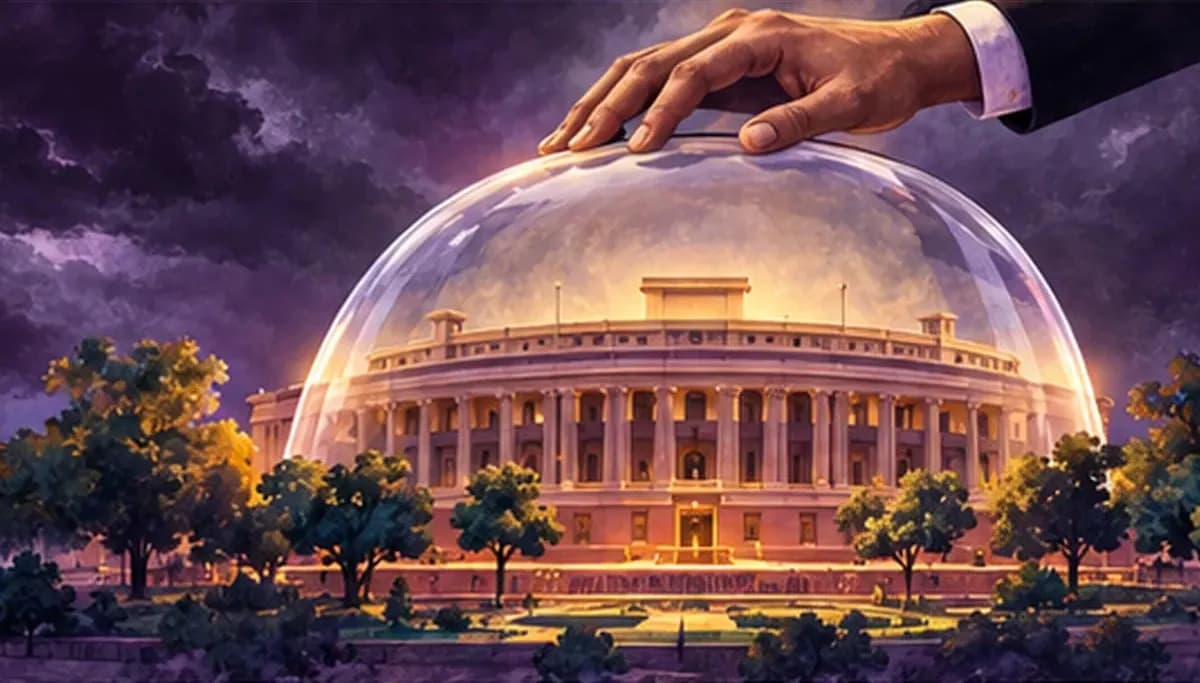
Article 355 places a duty on the Centre to ensure that the government of every state is carried on in accordance with the Constitution. It is in performing this duty that the Centre can take over a state’s government under Article 356.
The President can issue a proclamation if satisfied that the government of a state cannot be carried on in accordance with the Constitution.
The President can act on the Governor’s report — or otherwise, even without it.
If a state fails to comply with, or give effect to, any direction from the Centre, the President may lawfully hold that the state’s government cannot be carried on in accordance with the Constitution.
Note: A proclamation must be approved by both Houses of Parliament within two months; it then lasts six months at a time, up to a maximum of three years.
Two waves of mass dismissals
The new Janata Party government imposed President’s Rule in nine Congress-ruled states, including Bihar, saying their assemblies no longer reflected the wishes of the electorate.
The Congress, back in power, did the same in nine states, including Bihar, on the same ground.
Replying to critics in the Constituent Assembly, Dr. Ambedkar hoped this drastic power would remain a ‘dead letter’, used only as a last resort. But later events turned what was hoped to be a ‘dead letter’ into a ‘deadly weapon’ against many state governments and legislative assemblies.
The Supreme Court laid down propositions on the use of Article 356: it is an exceptional power, to be used only occasionally to meet special situations, and the President’s satisfaction must not be mala fide.
Example: Bommai also held that a proclamation can be reviewed by courts and that a government’s majority must be tested on the floor of the House.
The National Commission to Review the Working of the Constitution recommended that Article 356 be used sparingly, as a last resort, and truly to perform the duty in Article 355.
Both commissions on Centre–state relations shared the same view: Article 356 should be used sparingly, only as a remedy of last resort.
Bihar example: in the Rameshwar Prasad case (2006), the Supreme Court held that the 2005 dissolution of the Bihar assembly under President’s Rule was unconstitutional.
So, if federalism is to be truly followed, Article 356 must be read with Article 355 — as a means to protect the constitutional machinery in the states, not to replace elected governments.
Not all units are alike
The main units of India are the Centre and the states. But there are other forms too, each set up to address specific local, historical and geographical contexts: Union Territories with a legislature, and Union Territories without one.

When the Constitution came into force, the states and other units were divided into Parts A, B, C and D:
The former provinces.
The former princely states and principalities.
The former ‘Chief Commissioner’s Provinces’. They became Union Territories; some first got legislatures and were later upgraded to states — Himachal Pradesh, Manipur, Tripura, Mizoram, Arunachal Pradesh and Goa.
Example: The Andaman and Nicobar Islands.
Puducherry and Delhi have legislatures; the other territories under the Centre have no legislature or council of ministers to advise the administrator.
Can make laws on any matter in the State List or the Concurrent List, as far as it applies to the Union Territory.
Has the same field, with three exceptions — police, land and public order are outside its purview.
Parliament has overriding power over any law made by the assembly of a Union Territory.
Update: Since 2019, the Union Territory of Jammu and Kashmir also has a legislature.Puducherry has one more unique feature: though a single administrative unit, it is ‘non-contiguous’ — its territory is not one continuous piece of land. Besides Puducherry and its adjoining areas, it has enclaves inside other states:
Just as the Centre and the states do not have matching powers in all matters, some states and other units relate to the Centre differently. This creates a notable asymmetry in the way Indian federalism works.
Example: Special provisions for particular states under Articles 371 to 371J (for example, Nagaland, Mizoram and Sikkim) are another form of this asymmetry.

Exam preparation
Every question this page prepares you for, with the parts that answer it.
“Within the sphere allotted to them, the States are supreme.”
Curated for BPSC, UPSC & State PCS Civil Services Aspirants | Indian Polity Master Module