
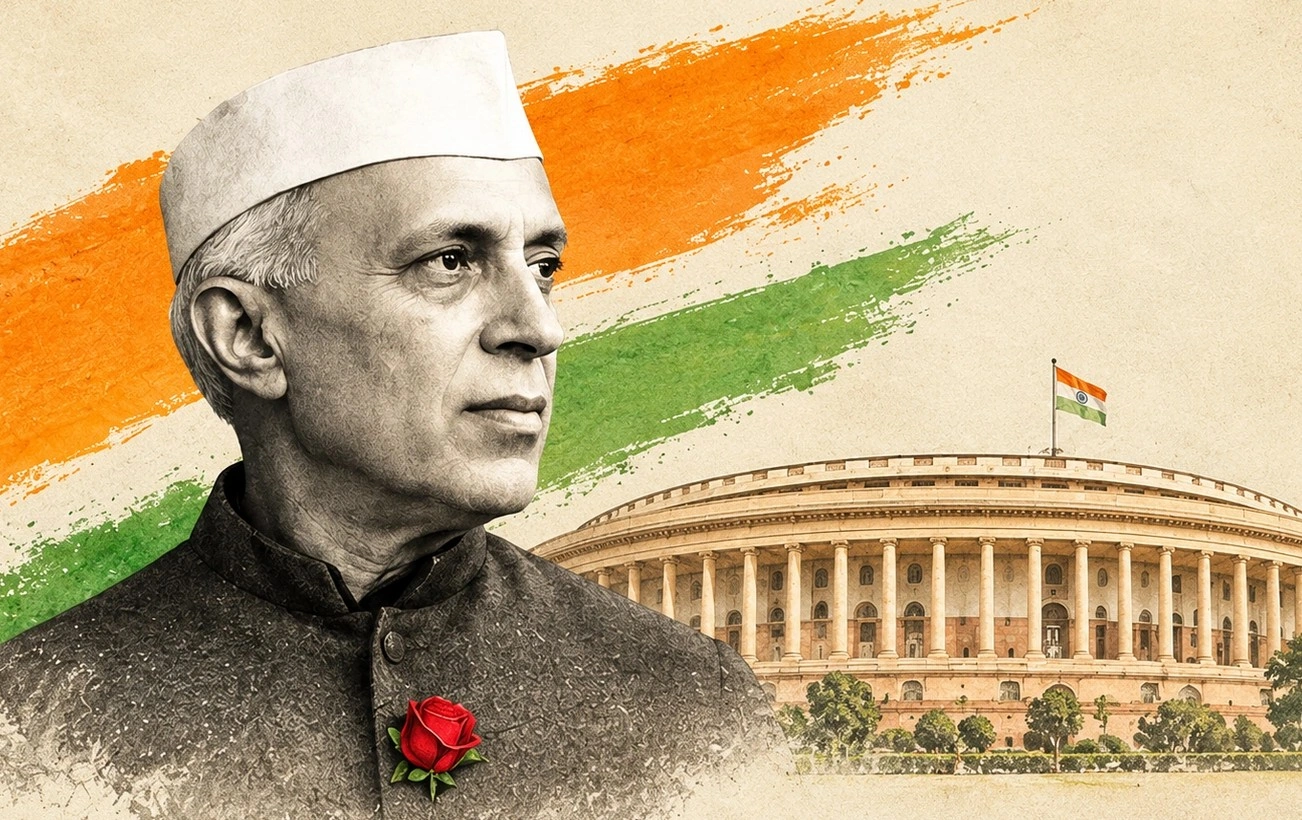
1889-1964A life in public service
The freedom struggle and the making of independent India.
Ideas · Institutions · Internationalism
The first Prime Minister's project of building a democratic, secular and modern India-and the difficult questions his legacy leaves behind.
The freedom struggle and the making of independent India.
The Lahore Congress declared complete independence as its goal.
Led the new republic through its formative years.
The Belgrade Summit gave shape to a collective movement.
The road to nation-building
Key moments connect Nehru's anti-colonial politics to the institutions and foreign-policy choices of independent India.
Joined the Home Rule movement
Brussels Congress
Congress Foreign Department formed
Lahore Congress
National Planning Committee
Imprisoned during the mass movement
Outlined India's foreign-policy goals
First Prime Minister
Five principles of peaceful coexistence
Bandung Conference
National Book Trust established
Belgrade Summit
A major foreign-policy setback
Building a republic
Nehru's early leadership focused on keeping a newly independent country together while establishing democratic processes that could outlast any one leader.
Nehru backed representative government, parliamentary debate and universal adult franchise. He treated democracy as more than elections: it also required civil liberty and social and economic opportunity.
Nehru joined the Home Rule movement, took part in Non-Cooperation, Civil Disobedience and Quit India, and was repeatedly imprisoned. At the 1929 Lahore Congress, which he presided over, the Congress adopted Purna Swaraj as its goal.
Nehru favoured gradual social and economic change through democratic institutions rather than violent revolution. His vision joined political democracy with a larger goal of reducing inequality and expanding opportunity.
The early republic faced Partition, princely-state integration, linguistic demands and regional tensions. Nehru gave Sardar Patel room to lead the integration of princely states, accepted linguistic reorganisation through the States Reorganisation Act of 1956 and backed continued use of English through the Official Languages Act of 1963.
The Balwant Rai Mehta Committee (1957) recommended democratic decentralisation. Its proposals helped shape the early Panchayati Raj system, formally inaugurated in Rajasthan in 1959.
Nehru favoured integration without forced assimilation: tribal communities should develop in keeping with their own cultures, with their land, forests and institutions respected. The Constitution's Fifth and Sixth Schedules and Article 46 provided safeguards and support.
Nehru's Objectives Resolution set out principles that influenced the Constitution's Preamble, including sovereignty, equality and justice. The Constitution, adopted by the Constituent Assembly, established the republic and its institutions.
His governments pursued legal equality through measures against untouchability and caste discrimination, labour protections, women's legal rights and reservations in education and public employment for historically disadvantaged communities.
Tribal development
Nehru's approach called for development with respect for tribal identity, community institutions and self-direction.
Avoid imposing outside values; respect tribal cultures and let communities shape their own development.
Respect tribal rights in land and forests, which are central to community life and livelihood.
Train and develop people from tribal communities to lead administration and development work.
Avoid over-administration and a flood of schemes; work through and strengthen community institutions.
Measure progress by the quality of life and capabilities developed, not only by money spent or statistics reported.
A planned economy
Planning sought to turn political independence into economic self-reliance. Public investment in agriculture, infrastructure, heavy industry and research was central; the gains and costs were uneven.
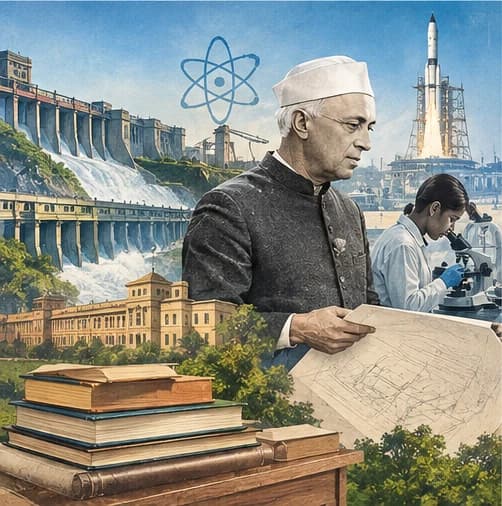
Dams, laboratories and technical institutions became symbols of planned development.
The ambition was to build national capacity through science, industry and education-not simply expand output in the short term.
Five-Year Plans coordinated public investment and aimed to expand production, infrastructure and living standards.
The state led investment in heavy industry and strategic sectors where private capital was limited.
Public and private enterprise operated together, with the state guiding major development priorities.
The first Plan prioritised agriculture. Community Development, land reform and major dams such as Bhakra-Nangal aimed to raise rural productivity and support wider growth.
Knowledge and cultural life
Nehru's nation-building programme treated education, research, publishing and the arts as foundations for a self-reliant and democratic society.
The Radhakrishnan Commission on university education led to the establishment of the UGC. IITs, IIMs, AIIMS and other technical and professional institutions helped train India's next generation of specialists.
Five-Year Plans set goals for free and compulsory primary education. New schools, village enrolment drives, adult-education centres and vocational training sought to widen access; reservations addressed barriers faced by Scheduled Castes and Scheduled Tribes.
Established in 1957, the National Book Trust supported authors and publishers and promoted the publication and wider availability of books.
Nehru's government supported national institutions for cultural life: the Sangeet Natak Akademi (1953), Sahitya Akademi (1954), Lalit Kala Akademi (1954) and National Gallery of Modern Art (1954).
Nehru stressed children's welfare and education as essential to India's future. His birthday, 14 November, is observed as Children's Day in India.
CSIR and the National Physical Laboratory helped build national research capacity. The Scientific Policy Resolution of 1958 set out a framework for science and technology.
The Atomic Energy Commission (1948), Department of Atomic Energy (1954) and Apsara reactor (1956) advanced nuclear research. INCOSPAR (1962) and the Thumba launch facility laid foundations for India's space programme.
Pluralism and equal citizenship
Nehru argued for a religiously impartial state that protects freedom of belief and does not privilege a single faith.
Religious freedom, equal citizenship and opposition to communalism belong in the same argument.
The state should not adopt an official religion or favour one faith over another. Equal citizenship and freedom of belief were central to national unity.
Nehru saw communal politics as a force that divided people and weakened the nation. He connected secularism with a rational, plural public culture.
He did not see secular government as barred from social reform. Hindu personal-law reforms and the Special Marriage Act of 1954 expanded legal options, while constitutional provisions addressed untouchability. The absence of a Uniform Civil Code and uneven reform remained contested questions.
Independent judgement abroad
Nehru sought room for India to make its own choices in a divided world, while supporting decolonisation and peaceful resolution of disputes.
Before independence, Nehru helped bring international affairs into Congress politics, including through the Brussels Congress against imperialism (1927) and the Congress Foreign Department (1928).
Non-alignment meant independent judgement during the Cold War-not isolation or automatic neutrality. India sought friendly relations with both the United States and the Soviet Union and accepted assistance from each without joining either bloc.
Nehru's diplomacy was not automatic support for either power bloc: India advocated a negotiated end to the Korean War and criticised the Soviet invasion of Hungary in 1956.
Panchsheel, agreed with China in 1954, set out mutual respect, non-aggression, non-interference, equality and peaceful coexistence.
India supported liberation movements and decolonisation, opposed apartheid and raised racial discrimination at the United Nations. The Asian Relations Conference (1947) and Bandung Conference (1955) advanced Afro-Asian solidarity.
Nehru backed international cooperation and peaceful dispute resolution through the United Nations, including peacekeeping and mediation. India also chose to remain in the Commonwealth after becoming a republic.
India helped mediate during the Korean War, including work on the repatriation of prisoners of war, and an Indian emissary helped mediate between Indonesia and France in 1954.
India pursued friendship and cooperation with neighbouring states, including treaties with Nepal and Bhutan. Talks addressed border and Indian-settler issues with Burma; the status of people of Indian origin in Ceylon (Sri Lanka) remained difficult.
Partition left difficult questions over borders, Kashmir and river waters. Nehru took the Kashmir question to the United Nations; relations remained strained despite the Indus Waters Treaty of 1960.
India recognised China's position on Tibet in the 1954 agreement and supported its entry into the United Nations. The border dispute and 1962 war exposed grave failures in assessment and military preparedness.
India opposed the 1947 partition plan for Palestine, voted against Israel's admission to the United Nations in 1949 and recognised Israel in 1950, while continuing to support Palestinian rights.
A policy tested by events
The 1962 war with China exposed serious failures in India's assessment and preparedness. Relations with Pakistan also remained difficult, including over Kashmir, even as the Indus Waters Treaty was signed in 1960 with World Bank support.
Achievements and criticisms
A balanced answer recognises the institutions and democratic practices that endured while examining the unresolved problems and contested choices.
Enduring contributions
Unresolved questions
Nehru's project helped make a democratic republic durable; its unfinished social and economic promises remain part of the same historical story.
Exam preparation
Use each outline to build an answer with a clear argument, precise evidence and a critical conclusion.