
Always changing
It is an inherent characteristic of politics that its nature keeps undergoing continuous change.
How India adapted democracy into a uniquely Indian model: the trends in its parties and voters, the consensus and the challenges, and whether India can truly be called a liberal democratic state.
 Beginning1952First elections
Since then, the process has become increasingly free and fair.
 2019~90 croreEligible voters
2019: the largest democratic exercise in human history.
 Turnout67.1%Highest turnout
In 2019, up from 65.95% in 2014.
 Youth1.5 croreFirst-time voters
Voters aged 18–19: a younger, more aware electorate.
 Consensus4Points of consensus
Agreement among most parties amid fierce competition.
 CharacterLiberal?The big question
Rights, rule of law and checks, and the opposite view.
Emerging trends in Indian democracy
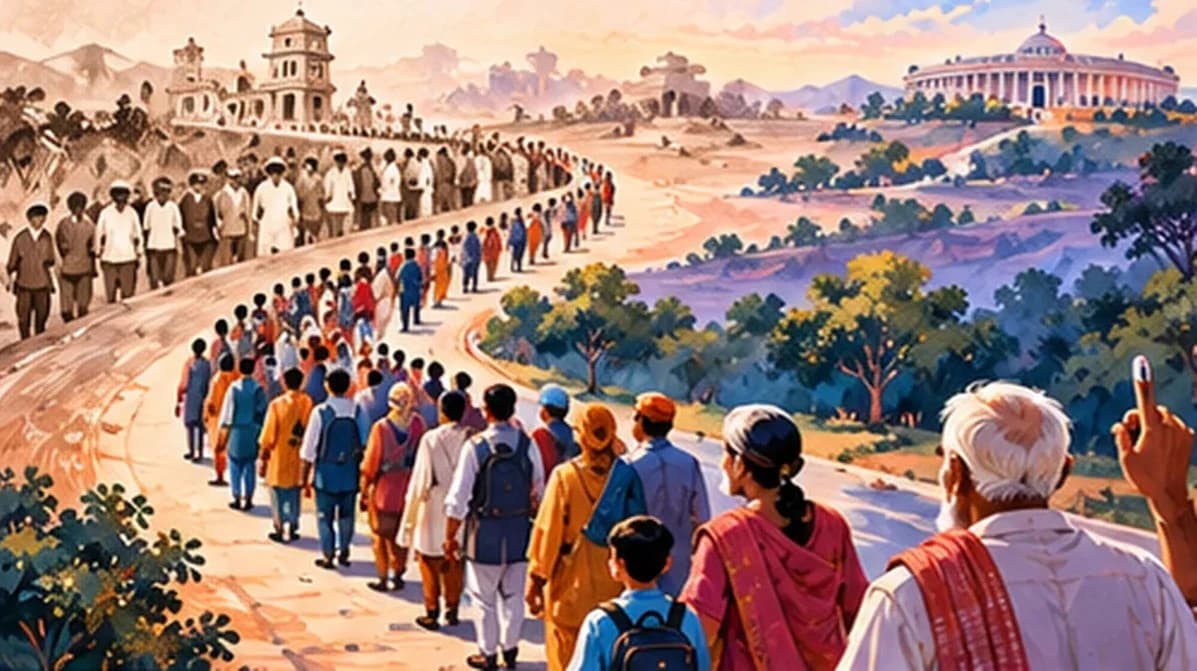
Since becoming independent from British rule, India has practised democracy, and over the past 70 years it has also adapted the concept to create a uniquely Indian model.
It is an inherent characteristic of politics that its nature keeps undergoing continuous change.
Indian democracy has developed its own incremental trends, mainly influenced by a pluralistic society with many minorities in terms of religion, caste and language.
The prevailing multi-party system emerged as an antidote to the monolithic Congress Party.
From the first elections in 1952, the process has become increasingly free and fair, although these qualities have not yet been established across the entire nation.
However, the maturing of democratic traditions is visible across the board.
Emerging trend: the party system
The move towards centralisation of power, and the re-emergence of a single dominant party in the last two elections, for the first time after two decades.
These results were similar to those of elections held in the immediate post-independence era, when the Congress held electoral hegemony across the entire nation.
People’s trust in the Congress Party continued for about 15 years in the post-independence jubilation.
By the late 1960s, regional and caste-based parties had started to come to power in the states. However, the Congress continued to win a majority in central elections, staying in undisputed power and in control of the nation.
By the early 1990s, another visible trend had manifested itself in Indian electoral politics: the politics of coalitions.
A single party once again dominated, and the coalition trend began to be reversed.
Why the coalition era arrived
These have been the coalition governments in India.
Thus, the trend of coalition is gradually being reversed.
However, pre-poll alliances are still prevalent.
This process started after 1989 and is more prominently visible in the last two elections.
Emerging trend: the electorate
A presidential style of contest, a focus on national issues, more parties than ever, the limits of identity politics and record turnout.
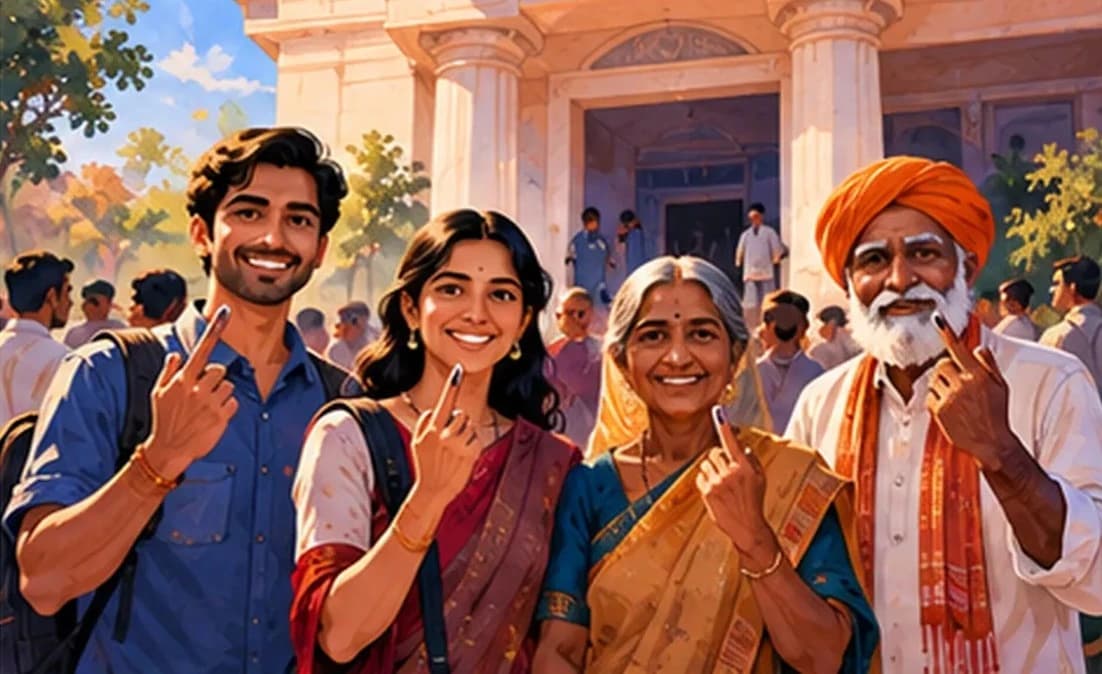
Elections fought around one leader.
Emerging trend: consensus amid competition
On many crucial issues, a broad agreement has emerged among most parties. In the midst of severe competition and many conflicts, a consensus appears to have emerged among most parties. This consensus consists of four elements.
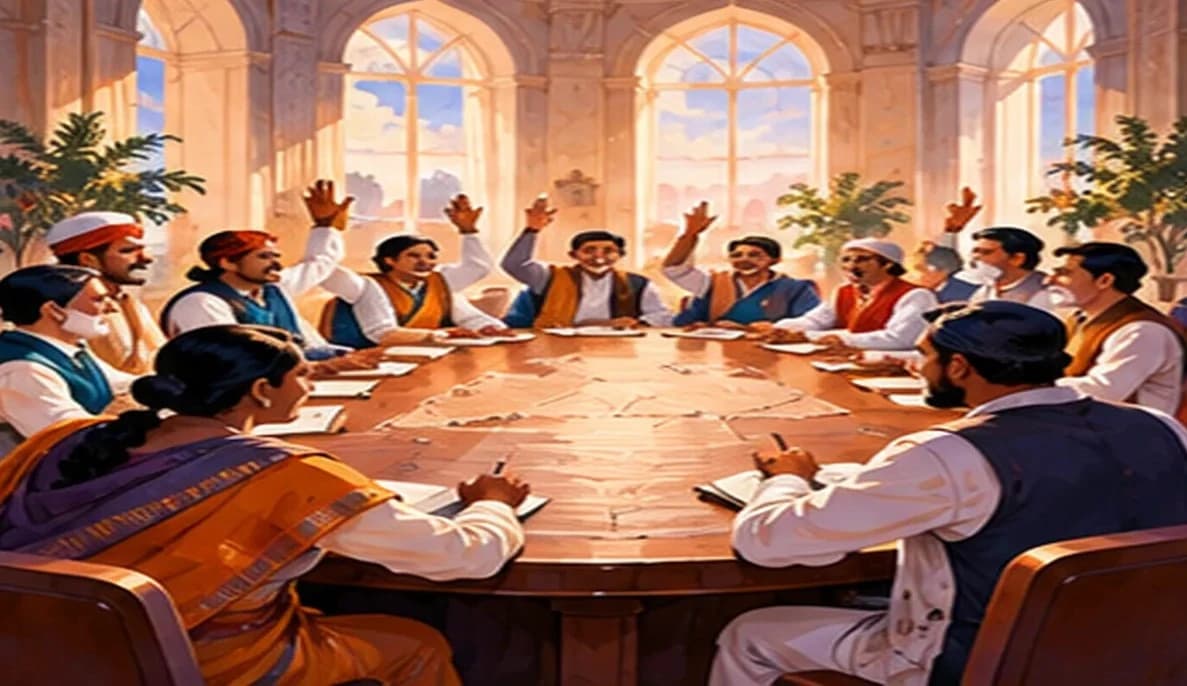
While many groups oppose the new economic policies, most political parties support them. Most parties believe these policies will lead the country to prosperity and the status of an economic power in the world.
Political parties have recognised that the social and political claims of the backward castes need to be accepted. As a result, all political parties now support reservation of seats for the ‘backward classes’ in education and employment. Parties are also willing to ensure that the OBCs get an adequate share of power.
The distinction between state-level and national-level parties is fast becoming less important. State-level parties are sharing power at the national level and have played a central role in the country’s politics over the last twenty years or so.
Emphasis on pragmatic considerations rather than ideological positions, and political alliances without ideological agreement. Coalition politics has shifted parties’ focus from ideological differences to power-sharing arrangements.
Thus, most parties of the NDA did not agree with the BJP’s ‘Hindutva’ ideology. Yet they came together to form a government and remained in power for a full term.
The political processes unfolding around us after the 1990s show the emergence of broadly four groups of parties:
The situation suggests that political competition will be multi-cornered. By implication, it also assumes a divergence of political ideologies.
Emerging trend: wider participation
Wider affirmative action, new ways to campaign, more tools for citizens to take part, and a bigger role for civil society and local governments.
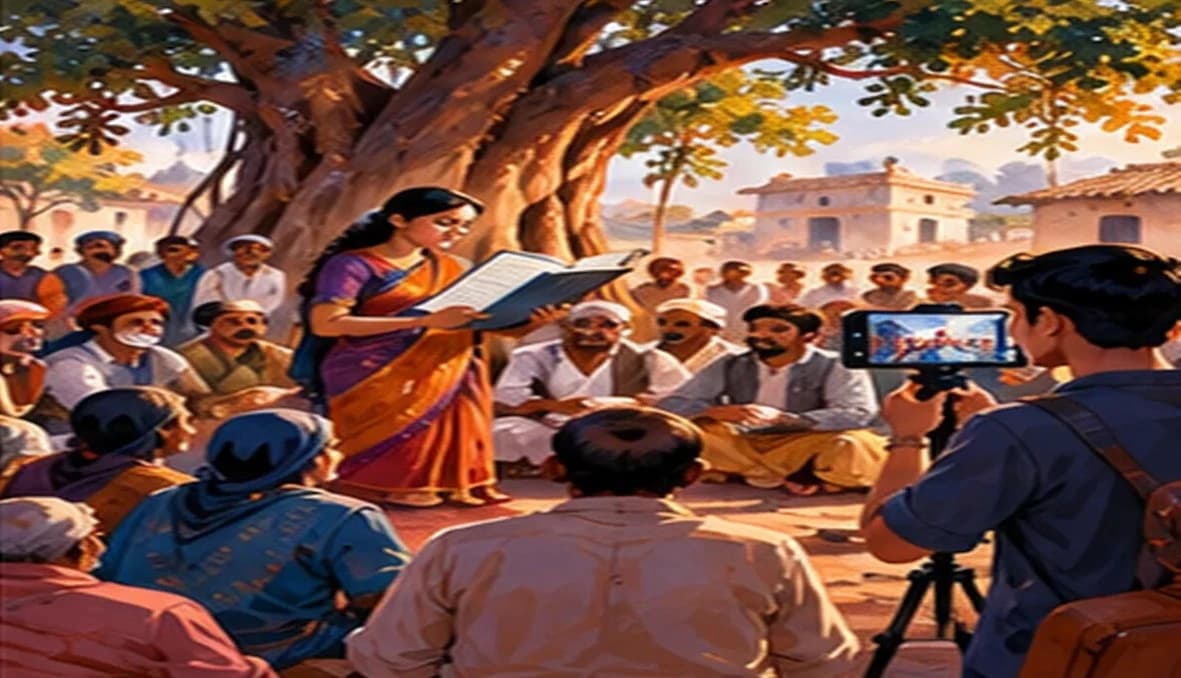
Affirmative action is being broadened:
Reservation in promotion.
Extending the policy of reservation to the economically deprived class as well.
Example: The 103rd Constitutional Amendment (2019) created a 10% reservation for the Economically Weaker Sections (EWS) in education and government jobs.
New ways of campaigning — e.g. social media, virtual rallies, etc.
Moving towards more and more participative democracy through RTI, citizen charters, social auditing and 360-degree appraisal.
Example: Under MGNREGA, the Gram Sabha conducts a social audit of the works done and the wages paid in the village, so villagers themselves can check the accounts.
There is also an increasing role for civil society, local governments, etc. They helped immensely in the fight against corona.
Negative trends: challenges for democracy
However, some negative trends are also visible, which can be seen as challenges for democracy:
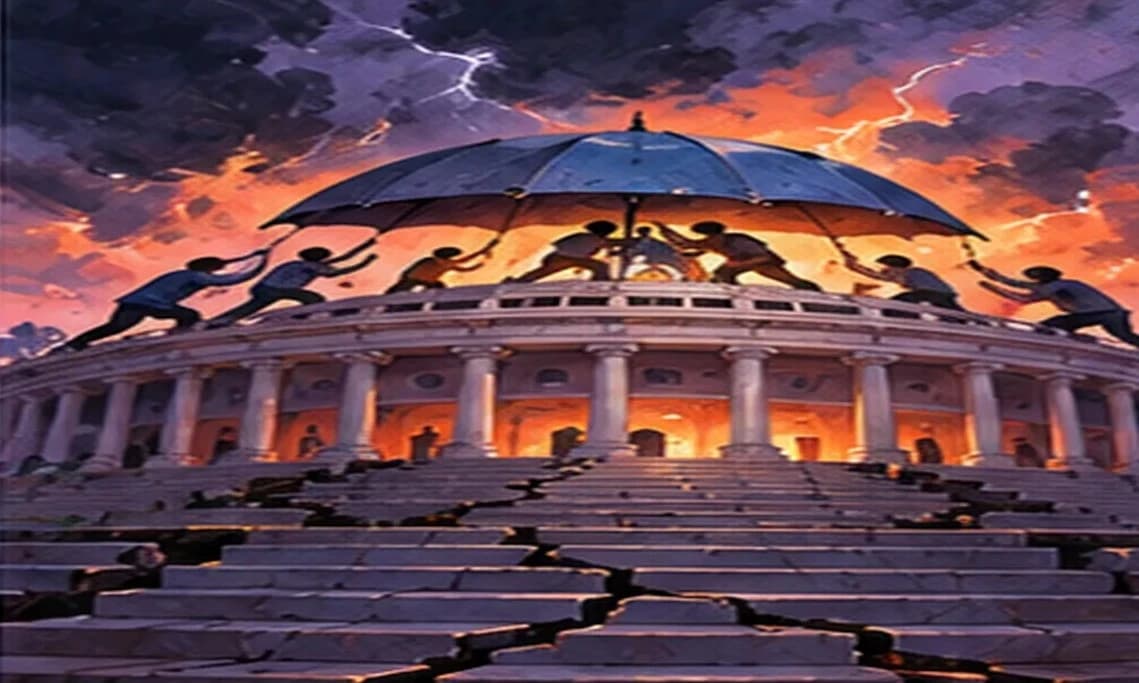
Criminalisation of politics.
Opportunistic alliances to obtain political power without any ideological affinity.
e.g. the Shiv Sena and Congress alliance in Maharashtra, BJP alliances in Bihar, etc.
Less inner-party democracy.
The declining position of the legislature. The anti-defection law limits legislators in exercising their conscience.
Political horse-trading in various states — e.g. in Karnataka and Madhya Pradesh. The role of the Governor and the Speaker has been questioned on various occasions.
Rising NOTA votes, signalling a loss of trust.
Example: NOTA (‘None of the Above’) was added to voting machines in 2013 after a Supreme Court judgment, so a voter can reject all candidates and still vote secretly.
Hate speech and violations of the Model Code of Conduct.
Weakening of the RTI Act.
Even though these emerging trends are visible, we cannot predict the future of democracy. All we know is that democratic politics is here to stay in India, and that it will unfold through a continuous churning of multiple factors.
India as a liberal democratic state
The features that make a democracy ‘liberal’, and the Indian liberal tradition from which ours grew.
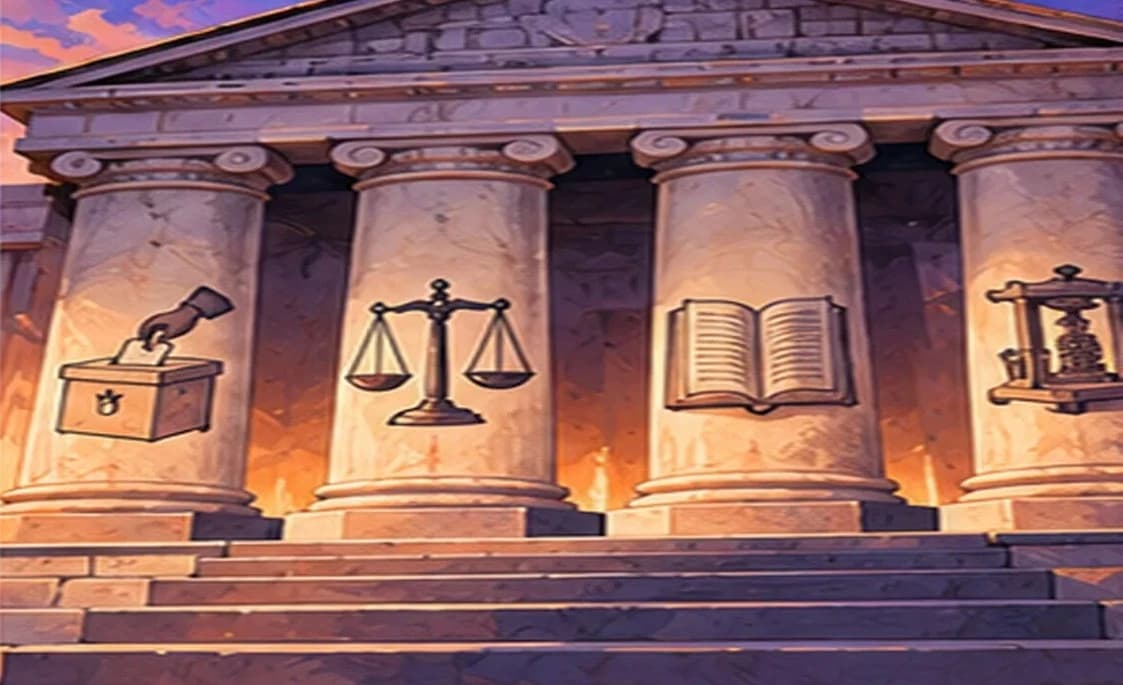
A liberal democracy is a liberal political ideology and a form of government in which representative democracy is characterised by:
To define the system in practice, liberal democracies often draw on a constitution, either codified (as in the United States of America) or uncodified (as in the United Kingdom), to set out the powers of government and enshrine the social contract.
After a period of sustained expansion throughout the 20th century, liberal democracy became the predominant political system in the world.
India has had a strong modern liberal tradition since the 19th century, emphasising rights, the separation of powers, a free press and the rule of law, among other features.
Figures like Dadabhai Naoroji and Rammohan Roy were liberal progressives. They fought for constitutional restraints on the British East India Company, advocated a republican spirit and local representation, and believed in the value of a free press to expose abuses of authority and power.
Liberal democracy in India emerged in the context of anti-colonial nationalism.
Comment: India is a liberal democratic state
The constitutional and institutional features that make India liberal, and the opposite view that points to gaps in practice.
The Preamble of the Constitution envisaged establishing a secular, socialist, democratic and republic state. It also sought to secure to all citizens justice (social, political and economic), liberty (of thought, expression, belief, faith and worship), equality of status and of opportunity, and to promote fraternity among all.
The existence of fundamental rights in the Constitution.
Example: Right to Equality (Articles 14–18), Right to Freedom (19–22), Right against Exploitation (23–24), Right to Freedom of Religion (25–28), Cultural and Educational Rights (29–30), and the Right to Constitutional Remedies (32).
The existence of a multi-party system.
A truly independent judiciary as the ultimate defender of the liberal values embodied in the Constitution.
The DPSPs seek to establish a welfare state.
A powerful and impartial Election Commission, known for its credentials in conducting free and fair elections.
Hillary Clinton once called India’s election system a ‘golden standard’.
Legislation like the RTI Act has increased citizens’ access to information.
Practices like citizen charters, social auditing and 360-degree appraisal have also empowered citizens to claim services with dignity.
Flourishing civil society, free media, etc.
Liberalism is an essential quality in a democracy because it is meant to protect the excluded. It is a humanitarian ethic that treats everyone equally, guaranteeing basic respect and dignity — without exception. It carries an unsentimental insistence on rights.
The full virtues of a democracy can be enjoyed only when it acts in conjunction with the virtues of liberalism. It is liberal values that guarantee the universality of certain basic rights, fundamental freedoms and human dignity, regardless of popular opinion.
We can’t claim that we have completely realised the ideals of liberal democracy. But with our Constitution as a guiding light, we are surely moving in this direction.

Exam preparation
Every question this page prepares you for, with the parts that answer it.
“Democratic politics is here to stay in India.”
Curated for BPSC, UPSC & State PCS Civil Services Aspirants | Indian Polity Master Module