EDU TERIA Logo
CartSign InSign UpEnroll Now
Back Indian Economy & Geography
BPSC Mains GS-2 Masterclass · Indian Economy & Geography

Green Revolution, Soils & EnvironmentFeeding India, at a Cost

In the mid-1960s India was importing grain; the Green Revolution turned it into a food-surplus nation. But the same seeds, water and chemicals exhausted soils, drained aquifers and poisoned rivers. This page explains both sides, and the soils on which India's farming depends.

Output72 → 303 MTFoodgrains

1965-66 to 2020-21.

Wheat4×+Wheat yield

8.3 to 35+ quintals a hectare.

Water165%Punjab extraction

of natural groundwater recharge (2018).

Soil11–26%Of GDP lost

to soil degradation in the 1980s–90s (estimate).

Soils42%Alluvial soil

share of India's soils.

Peat40–50%Organic matter

in peaty soils, as in north Bihar.

Part 1 · What the Green Revolution was

The Green Revolution: Seeds, Water and Chemicals

How high-yielding varieties, irrigation and fertilisers came together in the 1960s, and why the technology favoured some regions and farmers.

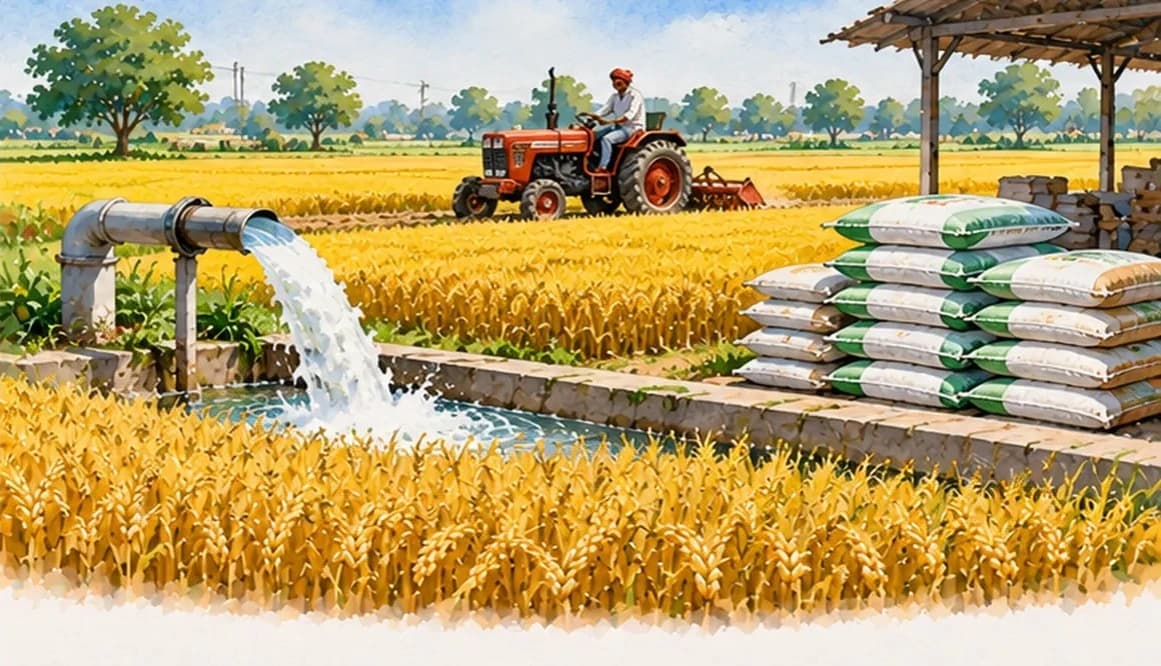
Golden wheat fields in Punjab with a tubewell, a tractor and stacked fertiliser bags

The Green Revolution

"Green revolution" refers to substantial increase in grain yield obtained by plant breeders by developing new crop varieties. The high yielding varieties (HYVs) of wheat and rice have been the key elements in green revolution. Although initially the new agricultural strategy was limited mainly to wheat and rice crops, later it spread to other crops.

In 1960s, two major programmes viz. Intensive Agriculture Area Programme (IAAP, 1961) and Intensive Agriculture District Programme (IADP, 1964) were launched in India. These two programmes made large investments in irrigation, fertilizer, agricultural R&D, education, and extension services which together led to a period of high growth in productivity and production in Indian agriculture, popularly referred to as the green revolution (GR). It was mainly led by agricultural scientist M. S. Swaminathan in India.

What soil is

Soil is the mixture of rock debris and organic materials which develop on the earth's surface. Components of the soil are mineral particles, humus, water and air.

Various scientific surveys conducted by agencies like Soil Survey of India, the National Bureau of Soil Survey and Land Use etc have classified the Indian soils on the basis of their nature and character.

The factors which helped bring about the green revolution

  • Introduction of high yielding varieties of crops.
  • Multiple cropping, better irrigation and sufficient supply of fertilizers.
  • Use of crop protection measures against disease and pest.
  • Transfer of the technology of scientific farming from research farms to village farmers.
  • Better arrangements for transporting farm produce from fields to the market.
  • The impetus for the Green Revolution came from harvest failures and famine conditions in the mid-1960s. And its main goal was to ensure India's national food security, more precisely its self-reliance in foodgrain production.

Features of the Green Revolution

(Mention only briefly in the answer.)

  • Unlike the traditional farm practices which mostly relied on indigenous seeds and internal inputs (non-purchased inputs), the new agricultural technology was mainly based on external inputs (purchased inputs) which required substantial financial resources for its adoption.
  • The GR technology came in a package of HYV seeds – irrigation – fertilizers. All these are needed together in correct proportions as both inadequacy and excessive use of water were harmful to these seeds.
    • Availability of assured and controlled irrigation and use of chemical fertilizers thus became the two critical factors in raising the productivity of HYV seeds.

    Example: An HYV wheat seed is like a high-performance engine: it gives far more grain, but only with the right 'fuel' of water and fertiliser at the right time. Without them it may yield less than an old local variety.

  • Therefore, GR technology was more suited to the areas that had adequate irrigation facilities as well as proper water irrigation/drainage system.
  • While on the one hand the HYV seeds required high doses of chemical fertilizers for their growth, the use of fertilizers in turn generated weeds, requiring the application of weedicides.
  • One of the key features of HYV seeds is that they had shorter period of maturity which gave opportunity to farmers to grow more number of crops in a year. Thus, the GR technology helped increase cropping intensity.
  • However, in order to release the land for next crop, farmers needed to do various farm operations, including crop harvesting and land preparation for the next crop, in time. For this, use of modern farm machines such as tractors, threshers, irrigation pumps, etc were required.
  • Thus, the GR technology helped in attracting more investment in manufacturing of farm machines, irrigation pumps, etc. and also to set up banking and marketing infrastructure facilities in small towns and rural areas.
  • As a result, in the first phase of the green revolution (approximately mid 1960s up to mid 1970s), the use of HYV seeds was restricted to the more affluent states such as Punjab, Andhra Pradesh and Tamil Nadu. Further, the use of HYV seeds primarily benefited the wheat-growing regions only.
    • In the second phase of the green revolution (mid-1970s to mid-1980s), the HYV technology spread to a larger number of states and benefited more variety of crops.
  • Since the GR technology involved heavy infrastructural investment, the technology was more suited to the big farmers who could afford to purchase the farm machines and equipments optimizing their use because of their large farm sizes.
  • Though investment on heavy machinery was necessary for adoption of HYV crops, more investment on hiring and purchase of other inputs were essential even on small farms.
  • Small and marginal farmers had no capacity to invest since access to credit was limited. Thus, although the HYV-fertilizer-irrigation technology was considered scale-neutral and increased the land productivity irrespective of the size of operational holdings, in practice it was certainly not resource-neutral.
  • In brief, therefore, the HYV seeds, use of chemical fertilizers and pesticides, application of modern farm machines, extensive irrigation facilities, multiple cropping, improved credit facilities, support price policy and improved R&D and extension infrastructure came to signify the main features of the green revolution movement in India.
“Shift from 'green revolution led' productivity to 'green methods' led sustainability in agriculture.”
— BPSC Mains answer, 2009

Curated for BPSC, UPSC & State PCS Civil Services Aspirants | Indian Economy & Geography Master Module