


1
Chief executive head
The Governor is the chief executive head of the state. But, like the President, he is a nominal executive head (a titular or constitutional head).
The constitutional head and the real executive: the Governor’s powers, actual position and discretion (and his role in Bihar), how the Chief Minister is appointed and what he does, and the record of Chief Minister Nitish Kumar.
 ConstitutionArts 153–167The state executive
Part VI of the Constitution.
 GovernorDual roleHead & agent
Constitutional head of the state, and representative of the Centre.
 Legislature1/6Council nominees
Of the Legislative Council, nominated by the Governor.
 Ordinances6 weeksOrdinance life
From the legislature’s reassembly, unless approved.
 Chief MinisterArt. 164CM appointed
By the Governor; the real executive is the CM.
 Bihar50%Women in panchayats
Bihar was the first state to reserve half the seats.
The state executive
Articles 153 to 167 in Part VI of the Constitution deal with the state executive.
The Governor is the chief executive head of the state. But, like the President, he is a nominal executive head (a titular or constitutional head).
The Governor also acts as an agent of the central government. Therefore, the office of Governor has a dual role.
Usually there is a Governor for each state, but the 7th Constitutional Amendment Act of 1956 made it possible to appoint the same person as Governor of two or more states.
The powers and functions of the Governor can be studied under the following heads:
Powers of the Governor
From appointing the Chief Minister and key officials to recommending President’s Rule and acting as chancellor of universities.
All executive actions of the state government are formally taken in his name.
He can make rules specifying how orders and other instruments made and executed in his name shall be authenticated.
He can make rules for the more convenient transaction of the state government’s business, and for allocating that business among the ministers.
He appoints the Chief Minister and other ministers. They also hold office during his pleasure.
There should be a Tribal Welfare minister, appointed by him, in the states of Chhattisgarh, Jharkhand, Madhya Pradesh and Odisha. The state of Bihar was excluded from this provision by the 94th Amendment Act of 2006.
He appoints the Advocate General of the state and decides his remuneration. The Advocate General holds office during the pleasure of the Governor.
He appoints the State Election Commissioner and decides his conditions of service and tenure of office. However, the State Election Commissioner can be removed only in the same manner and on the same grounds as a judge of a High Court.
He appoints the chairman and members of the State Public Service Commission. However, they can be removed only by the President, not by a Governor.
He can seek any information about the administration of the state’s affairs and proposals for legislation from the Chief Minister.
He can require the Chief Minister to submit for the council of ministers’ consideration any matter on which a minister has taken a decision but which the council has not considered.
He can recommend the imposition of constitutional emergency in a state to the President. During President’s Rule in a state, the Governor enjoys extensive executive powers as an agent of the President.
He acts as the chancellor of universities in the state. He also appoints the vice-chancellors of universities in the state.
Powers of the Governor
A Governor is an integral part of the state legislature. In that capacity, he has the following legislative powers and functions:
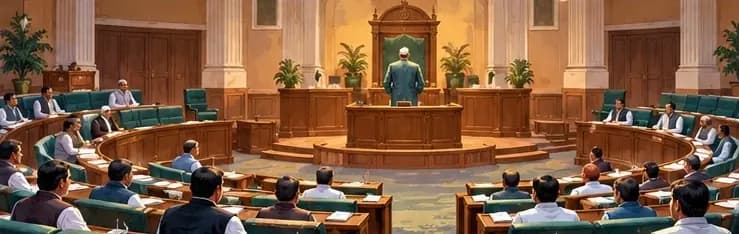
He can summon or prorogue the state legislature and dissolve the state legislative assembly.
He can address the state legislature at the start of the first session after each general election and the first session of each year.
He can send messages to the house or houses of the state legislature, about a bill pending in the legislature or otherwise.
He can appoint any member of the state legislative assembly to preside over its proceedings when the offices of both the Speaker and the Deputy Speaker fall vacant. Similarly, he can appoint any member of the state legislative council to preside when the offices of both the Chairman and the Deputy Chairman fall vacant.
He nominates one-sixth of the members of the state legislative council from among people with special knowledge or practical experience in literature, science, art, the cooperative movement and social service.
He can nominate one member of the Anglo-Indian community to the state legislative assembly.
He decides on the question of disqualification of members of the state legislature, in consultation with the Election Commission.
When a bill passed by the state legislature is sent to the Governor, he can:
In addition, the Governor can also reserve a bill if it is:
He can promulgate ordinances when the state legislature is not in session. These ordinances must be approved by the state legislature within six weeks of its reassembly. He can also withdraw an ordinance at any time. This is the Governor’s most important legislative power.
He lays the reports of the State Finance Commission, the State Public Service Commission and the Comptroller and Auditor-General relating to the state’s accounts before the state legislature.
Powers of the Governor
The budget, money bills and the Contingency Fund; pardons, and a say in appointing judges.
The actual position of the Governor
He is appointed by the President by warrant under his hand and seal. In a way, he is a nominee of the central government.
But, as the Supreme Court held in 1979, the office of Governor of a state is not employment under the central government. It is an independent constitutional office and is not under the control of, or subordinate to, the central government.
The Constitution of India provides for a parliamentary form of government in the states, as at the Centre. So the Governor has been made only a nominal executive; the real executive is the council of ministers headed by the Chief Minister. In other words, the Governor has to exercise his powers and functions with the aid and advice of the council of ministers headed by the Chief Minister, except in matters where he is required to act in his discretion (i.e. without the advice of ministers).
In estimating the Governor’s constitutional position, particular reference has to be made to Articles 154, 163 and 164:
The executive power of the state shall be vested in the Governor and shall be exercised by him either directly or through officers subordinate to him, in accordance with this Constitution.
There shall be a council of ministers with the Chief Minister as the head to aid and advise the Governor in the exercise of his functions, except in so far as he is required to exercise his functions in his discretion.
The council of ministers shall be collectively responsible to the legislative assembly of the state. This provision is the foundation of the parliamentary system of government in the state.
From the above, it is clear that the constitutional position of the Governor differs from that of the President in two respects:
| The Governor | The President |
|---|---|
| The Constitution envisages the possibility of the Governor acting in his discretion at times. | No such possibility has been envisaged for the President. |
| No provision makes ministerial advice binding on the Governor. | After the 42nd Constitutional Amendment (1976), ministerial advice has been made binding on the President. |
The Constitution makes it clear that if any question arises whether a matter falls within the Governor’s discretion or not, the Governor’s decision is final, and the validity of anything he does cannot be called in question on the ground that he ought or ought not to have acted in his discretion.
Discretion and special responsibilities
Where the Governor can act on his own judgement — written into the Constitution, arising from political situations, or assigned by the President.
In addition to this constitutional discretion (i.e. the express discretion mentioned in the Constitution), the Governor, like the President, also has situational discretion (i.e. hidden discretion arising from the needs of a prevailing political situation) in the following cases:
Moreover, the Governor has certain special responsibilities to discharge according to directions issued by the President. Here, though the Governor has to consult the council of ministers led by the Chief Minister, he finally acts on his discretion:
Separate development boards for Vidarbha and Marathwada.
Separate development boards for Saurashtra and Kutch.
Law and order, for as long as the internal disturbance in the Naga Hills–Tuensang Area continues.
Administration of tribal areas.
Administration of the hill areas in the state.
Peace, and the social and economic advancement of the different sections of the population.
Law and order in the state.
A separate development board for the Hyderabad-Karnataka region.
Thus, the Constitution has assigned a dual role to the office of Governor in the Indian federal system. He is the constitutional head of the state as well as the representative of the Centre (i.e. the President).
In May 2005, after an election that gave no party a majority, Governor Buta Singh recommended dissolving the Bihar Assembly before it had even met. In Rameshwar Prasad v. Union of India (2006), the Supreme Court held the dissolution unconstitutional and criticised the Governor’s report.
When Nitish Kumar changed alliances, the Governor swore in each new government quickly: with the RJD-led Mahagathbandhan in August 2022 (Governor Phagu Chauhan), and with the BJP-led NDA again in January 2024 (Governor Rajendra Arlekar).
Governor Lt Gen Syed Ata Hasnain (retd) administered the oath to Samrat Choudhary, Bihar’s first BJP Chief Minister, after Nitish Kumar stepped down.
As chancellor of Bihar’s state universities, the Governor’s office has at times clashed with the state’s Education Department over appointments and control of universities.
The Chief Minister
The Chief Minister is the real executive authority at the state level. He is the head of the government.
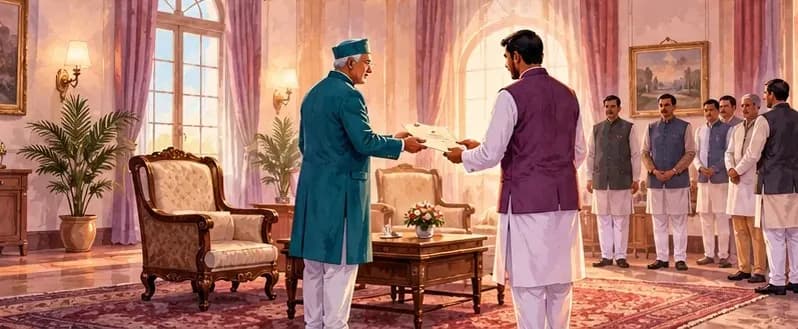
The Constitution does not contain any specific procedure for selecting and appointing the Chief Minister. Article 164 only says that the Chief Minister shall be appointed by the Governor.
However, this does not mean the Governor is free to appoint anyone as Chief Minister. In line with the conventions of the parliamentary system, the Governor has to appoint the leader of the majority party in the state legislative assembly as Chief Minister.
But when no party has a clear majority in the assembly, the Governor may use his personal discretion in selecting and appointing the Chief Minister. In such a situation, the Governor usually appoints the leader of the largest party or coalition as Chief Minister and asks him to seek a vote of confidence in the House within a month.
The Governor may have to use his individual judgement in selecting and appointing the Chief Minister when the Chief Minister in office dies suddenly and there is no obvious successor.
However, on the death of a Chief Minister, the ruling party usually elects a new leader, and the Governor has no choice but to appoint him as Chief Minister.
The Constitution does not require a person to prove his majority in the legislative assembly before being appointed Chief Minister. The Governor may first appoint him and then ask him to prove his majority in the assembly within a reasonable period.
A person who is not a member of the state legislature can be appointed Chief Minister for six months, within which he must be elected to the state legislature; otherwise he ceases to be Chief Minister.
According to the Constitution, the Chief Minister may be a member of either of the two Houses of a state legislature.
Powers and functions of the Chief Minister
As head of the council of ministers, the channel to the Governor, the leader of the House — and much more.
As head of the state council of ministers:
Thus, he plays a very significant and highly crucial role in the state administration. However, the discretionary powers enjoyed by the Governor reduce, to some extent, the power, authority, influence, prestige and role of the Chief Minister in the state administration.
Achievements of Chief Minister Nitish Kumar
Development, governance, power supply, climate action and women’s empowerment under Nitish Kumar’s governments.
Update (2026): Nitish Kumar stepped down as Chief Minister on 14 April 2026, and Samrat Choudhary (BJP) was sworn in as Chief Minister of Bihar on 15 April 2026. The achievements below are those of Nitish Kumar’s governments.
He is known for his dedication to his duties, development work and maintaining law and order. For this he has earned names like ‘Vikas Purush’, ‘Sushasan’, etc.
Under him, Bihar has been continuously registering a double-digit GDP growth rate.
The state government has also improved its budgetary allocation and operational efficiency through the CFMS (Comprehensive Financial Management System) since 2019.
Per capita consumption
Per capita electricity consumption in the state rose from 145 kWh in 2012–13 to 311 kWh in 2018–19, a growth of 114% in six years.
Hours of power a day
| Area | Before | Now |
|---|---|---|
| Rural | 6–8 hrs | 20–22 hrs |
| Urban | 10–12 hrs | 22–24 hrs |
The availability of power has increased from an average of 6–8 hours to 20–22 hours in rural areas, and from 10–12 hours to 22–24 hours in urban areas.
Power capacity available
The power capacity available in the state was 3,889 MW in 2018, which increased to 4,767 MW in 2019; to meet rising demand, the state government also planned additional capacity of 5,335 MW from different sources in a phased manner by 2021–22.
Climate change
The state government has also launched the flagship Jal-Jeevan-Hariyali programme to “tackle issues related to climate change and environmental degradation”.
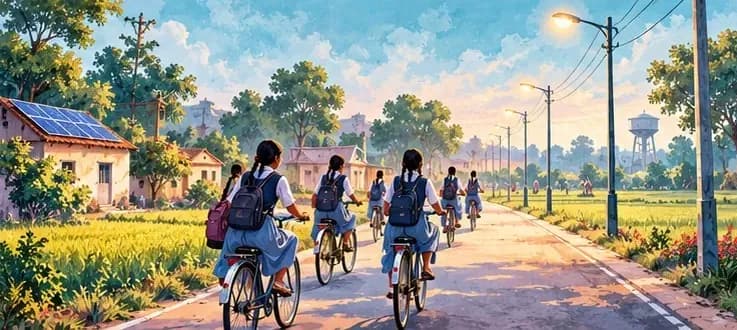
Under him, Bihar became the first state to give 50 per cent reservation to women (in 2005) in Panchayati Raj institutions. Many states followed, and the Centre is now also considering it.
35% reservation for women in state government jobs.
He made girls’ education a priority and started the cycle scheme for girls in Bihar. The scheme has been applauded the world over.
Students
He started a loan scheme for poor students of Bihar without any bank guarantee: the Student Credit Card Scheme.
Similarly, mention the state government’s other schemes for different sectors, and their results.
Example: Other well-known schemes of Nitish Kumar’s governments include the ‘Saat Nischay’ (seven resolves, 2015) such as Har Ghar Nal ka Jal (tap water to every home) and Har Ghar Bijli (power to every home); the JEEViKA self-help-group programme for rural women; and the Mukhyamantri Kanya Utthan Yojana for girls’ education.

Exam preparation
Every question this page prepares you for, with the parts that answer it.
“He is the constitutional head of the state as well as the representative of the Centre.”
Curated for BPSC, UPSC & State PCS Civil Services Aspirants | Indian Polity Master Module