

EDU TERIA Logo
CartSign InSign UpEnroll Now
BPSC Mains GS-2 Masterclass · Bihar Economy

Five-Year Plans & Poverty in BiharA Partial Success

Colonial exploitation, a feudal socio-economic structure and natural and technological factors left Bihar with large-scale poverty and mass deprivation. Plan after plan tried to change that. This page traces what the plans did, what they achieved, and why success was only partial.

Land reform1stTo abolish zamindari

Bihar was the first state in the country to abolish the zamindari system.

1951–56Rs 16.9First Plan outlay

per capita for Bihar, against Rs 25.6 for all States.

Stagnation0.35%Per capita growth

a year since the 1960s (1960–85).

2000s54.4→33.7%Poverty ratio

from 2004-05 to 2011.

Ceiling laws1.53%Land distributed

of cultivable land, against 20.51% surplus.

Instability20+Governments

in Bihar from 1961 to 1990.

Part 1 · Introduction

Poverty in Bihar and the Promise of Planning

How did Bihar become so poor, and what did seventy years of planning set out to do about it?

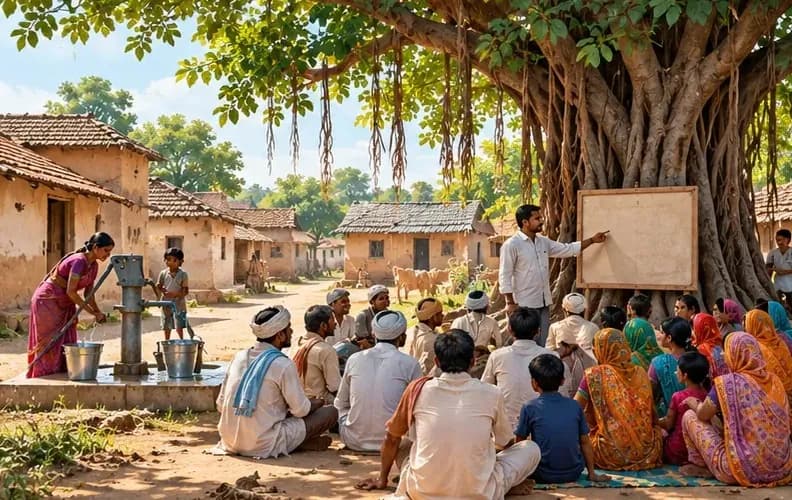
A Bihar village with mud houses, a hand pump and a government notice board under a banyan tree

Where the poverty came from

Bihar went through a long period of exploitation under colonial rule. Combined with feudal socio-economic structure as well as natural and technological factors, the colonial rule resulted into large-scale poverty and mass deprivation of Bihar.

After independence government has taken steps in various 5-year Plans but the success is only partially achieved.

How to write this answer

The plan-by-plan steps (Parts 2 and 3) are government steps under five years plans to remove poverty in India which were also applicable in Bihar.

It is not the core demand of question. You can mention few important schemes and program under this heading. The core is the record (Part 4) and the reasons (Parts 5–7).

Poverty ratio, 2011

  • Bihar33.7%
  • India21.9%

First Plan outlay per capita (Rs)

  • All States25.6
  • Bihar16.9

Example: Think of the Five-Year Plans as a national syllabus of development. Every state got the same chapters (land reform, industry, rural jobs, food), but how well a state learnt them depended on its own teachers: its administration, politics and society. That is why the same plans worked better in some states than in Bihar.

“Bihar has still long way to go to fully realise the constitutional goal of equal, just and prosperous state.”
— BPSC Mains answer, 2009

Curated for BPSC, UPSC & State PCS Civil Services Aspirants | Bihar Economy Master Module
