


EDU TERIA Logo
CartSign InSign UpEnroll Now
BPSC Mains GS-2 Masterclass · Indian Economy

Decentralised & District PlanningPlanning from the Bottom Up

Plans made in Delhi cannot see every village. Decentralised planning starts at the gram sabha and builds upward through the block and the district. This page explains the idea, the constitutional machinery, a blueprint for integrated planning, what district planning needs to succeed, and why it has fallen short.

Constitution243ZDArticle

creates the District Planning Committee.

DPC4/5thElected members

of a DPC are chosen by local elected members.

Funds44% vs 5%Own revenue

Urban vs rural local governments (ES 2017-18).

Structure3 tiersPanchayati Raj

Gram Panchayat, Panchayat Samiti, Zila Parishad.

Reform2015NITI Aayog

aims at a bottom-up approach to planning.

Record12States

reported integrated district plans (Devolution Report 2015).

Part 1 · Definitions

Decentralised Planning and District Planning

Two related ideas: planning that starts at the lowest unit of government, and planning for the district as the middle unit.

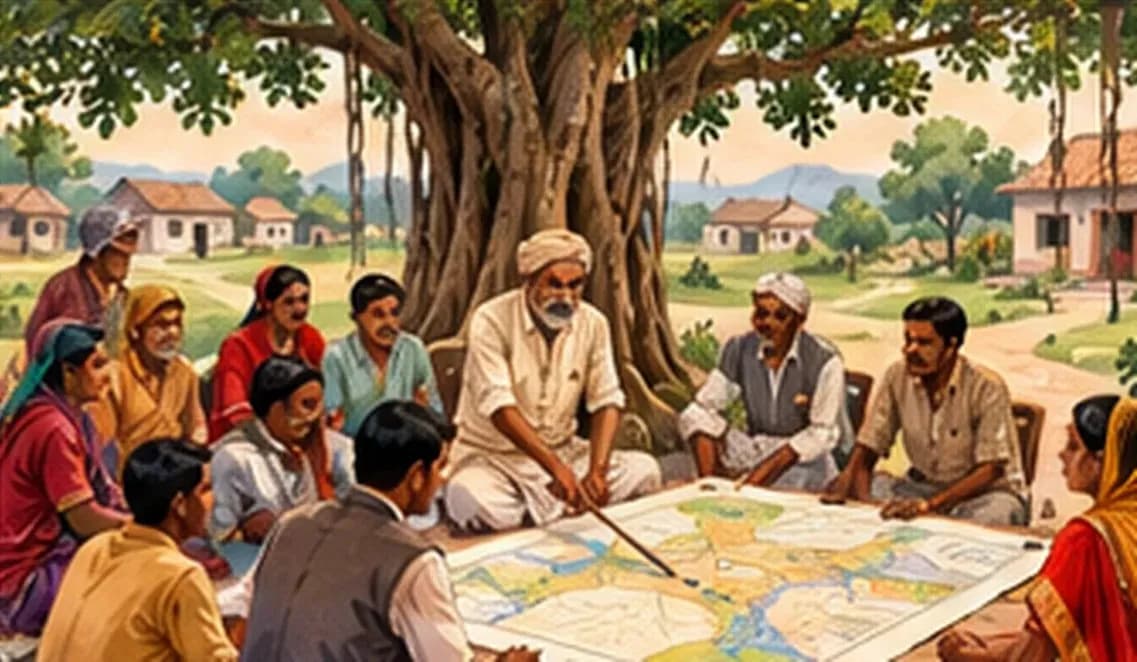
A gram sabha meeting under a tree with villagers marking needs on a large hand-drawn village map

Decentralised planning

Decentralized planning is an approach of planning where development plans are prepared at lowest unit of governance and administration and then aggregated upwards at the higher level of governance. It is also known as bottom up planning.

The main objective here is to facilitate people's participation and meeting the felt needs of all sections and all regions of a country with vast variations in terms of socio economic conditions and wider cultural diversity.

Since the inception of First Plan, the importance of decentralised planning was emphasised in order to achieve active people's participation in the planning process. However, this approach received further boost after 73rd and 74th amendment act.

District planning

District planning is a kind of area based sub-state planning and arises from the need to supplement the national and state plans with a more detailed examination of the resources, problems and potentials of local areas (i.e. districts), so that investment programmes, more specifically tailored to the particular needs of each district, could be evolved and implemented. It assumes that the district is a sub-state decision-making unit within the system of multi-level planning.

Requirement of district planning arises from the need to supplement the national and state plans with a more detailed examination of the potentials at the mid-unit of administration, i.e. the district. Such planning would help in making investment decision geared to the needs of each district. District planning, therefore, would involve striking a balance amongst specific needs of the people of the district, growth potentials of the area and budgetary allocations available.

District planning cannot be viewed in isolation from either the state plan, or the block level plan. Essentially, district planning should be a creative response to a particular set of prevailing circumstances in the State.

Example: Top-down: Patna decides every village needs a new community hall. Bottom-up: one village's gram sabha says its real need is a culvert over the canal, another wants a girls' toilet in the school. The district plan adds these up, so money goes where the felt needs are.

“Every district has to formulate its model of district development outlining its short-, medium- and long-term perspectives.”
— BPSC Mains answer, 1995

Curated for BPSC, UPSC & State PCS Civil Services Aspirants | Indian Economy Master Module
