


1
Weak Centre
Coalitions produce an unstable, weak government at the Centre.
Why no single party could rule alone after 1989, whether coalitions bring instability or balance, what they mean for democracy and cooperative federalism, and whether they have come to stay.
 The spark1967Non-Congressism
Opposition learns that divided votes keep the Congress in power.
 Janata1977First at the Centre
A coalition government is formed as the Janata Party.
 Coalitions1989Era of coalitions
The coalition era begins and becomes common in the 1990s.
 Stability3 + 1Full terms
Three Congress-led and one BJP-led government completed their terms.
 Representation31%Vote share, 2014
Enough for a BJP majority of seats, but votes were concentrated.
 1999–201415 yearsStable coalition rule
1999 to 2014, each anchored by a major party.
Coalition government
A coalition government is a form of government in which political parties cooperate, reducing the dominance of any one party within that ‘coalition’. The usual reason for this arrangement is that no party on its own can achieve a majority in the election.

A coalition government may also be created in a time of national difficulty or crisis (for example, during wartime or an economic crisis) to give the government a high degree of perceived political legitimacy or collective identity. It can also help reduce internal political strife.
e.g. After independence, Nehru gave representation to various parties in the Council of Ministers.
The coalition experiment in India is associated with the rise of regional parties and the decline of the Congress system. In a coalition government no party gets a clear majority, and two or more parties join together to form the government. In India, the period from 1989 onwards is known as the era of coalition government.
A coalition government was formed at the Centre for the first time, under the name of the Janata Party.
From 1989 onwards India entered the era of coalition government.
This form of government became more prevalent during the 1990s.
In the 16th general election in May 2014, the BJP secured a majority on its own (the first party to do so since the 1984 election), and the National Democratic Alliance came to power with Narendra Modi as Prime Minister.
In 2019, Narendra Modi was re-elected Prime Minister for a second time as the National Democratic Alliance again secured a majority in the 17th general election.
Moreover, the present government is also a coalition government. It is argued that this is a ‘surplus coalition’: a government featuring a party that already has the strength to form a government on its own but has taken other coalition partners on board.
Example: In 2014 the BJP alone won 282 of 543 Lok Sabha seats, more than the 272 needed, yet it still gave ministerial berths to NDA allies such as the Shiv Sena, TDP, LJP and Akali Dal.
Causes of emergence
From the 1967 spark of ‘non-Congressism’ to the need for a government that represents all of India: five sets of reasons.

How the Congress system gave way, step by step.
Points against coalition government
Why critics say coalitions give India a weak Centre, policy paralysis and a ‘circus’ of government formation.

Coalitions produce an unstable, weak government at the Centre.
In the coalition era, the politics of ‘support from outside’ has made the office of the Prime Minister a ‘lottery’, and this has decisively weakened governance at the Centre.
Example: Chandra Shekhar’s government (1990–91) survived only on the Congress’s support from outside, and fell within months when that support was withdrawn.
Every coalition partner tries to assert its own geographical, cultural and economic interests in the political process. Regional parties emphasise the development of their own region instead of focusing on the development of the nation as a whole.
Coalitions of convenience tend not to have coherent policy agendas and tend to be divided from within. The coalition government turns into a ‘collision’ government, leading to policy paralysis.
Whether they can frame policies, and whether they can put together a working Cabinet, are two separate but important issues for a working coalition.
Coalitions of convenience are more likely to be corrupt and to spend more money than ideological ones, because everyone has a hand in the pot.
As regional parties grew in influence, the vote share of national parties fell. In extreme cases, the national party had no influence or input in state governance, so a centralised direction for a concerted national development agenda became almost impossible to craft and implement.
With many regional parties represented at the Centre, the clear line between the national interest and parochial state concerns began to blur. National development initiatives got skewed, or stopped altogether, when regional or state interests were imposed on them.
Forming a government started to become a political ‘circus’, which people watch with alacrity and disdain. Progress as a nation became a low priority in the scramble for power, with ministerial berths grabbed in return for ‘support’ in the legislature.
The 2014 voting pattern shows voters’ impatience with coalition politics, which has delayed, and at times stopped, the implementation of national development policies.
Coalition governments have failed regularly and repeatedly in the past.
It seems to be the only answer for failing political parties that see no other option for their own survival.
A two-party or tighter competition would result in greater spending on public goods, while a fragmented party system leads to greater distribution of ‘club goods’: spending on specific communities represented by smaller parties in some states. This is at the state level. So, yes, you get redistribution, but not necessarily in the way you would ideally want.
Example: A public good is something everyone can use, like a highway or a government school. A club good is aimed at one group, like a scheme or hostel meant only for one caste or community that a small party represents.
Points in favour of coalition government
Why supporters say the evidence does not show coalitions as unstable, and why their caution can be a strength.

1 · They do last
The criticism that coalitions do not last their terms is not borne out by evidence.
Three Congress-led governments and one BJP-led government were able to complete their full terms.
Coalition governments are not necessarily truly democratic, but they can at least be plural in the views they represent.
In India, coalitions are associated with periods of greater economic growth, less economic volatility and more foreign investment.
The government’s policies have more credibility, because a coalition finds it harder to make radical changes.
Something like demonetisation would have been hard to conceive in a coalition government of somewhat equal partners, or one whose largest member was truly dependent on its allies.
The participation of regional parties at the Centre has significantly affected India’s federal structure. The formation of coalition governments has, to a large extent, led to a deviation from the centralising character of Indian federalism. With the emergence of regional parties, the demand for state autonomy has increased drastically.
Has the coalition experiment strengthened democracy?
Two sides of the argument: coalitions as a source of instability and identity politics, or as a guarantee of pluralism and accountability.
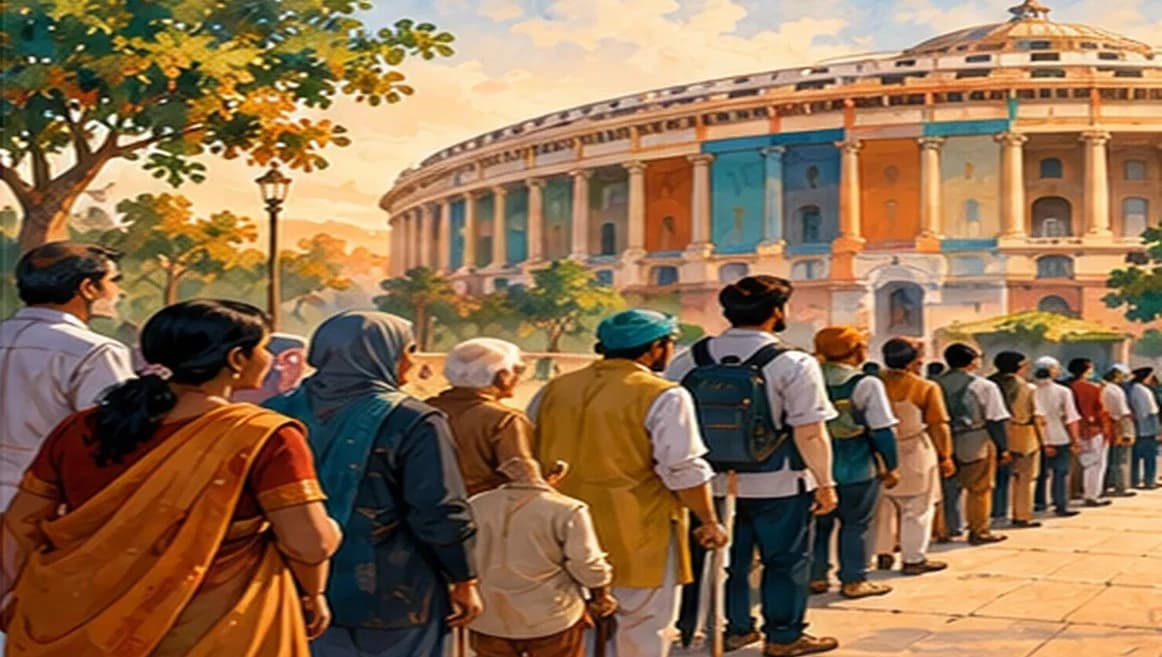
Coalitions cause unstable governments and lead to frequent elections. During elections, corruption, social division and identity-based political mobilisation take place, which weakens our social fabric.
Regional parties generally flaunt caste and regional identity, which impedes the goal of national integration.
Frequent elections create a huge burden on the exchequer.
Policy paralysis due to the lack of consensus in decision-making.
Everyone gets a hand in the pot, leading to more corruption.
Opportunistic coalitions are not based on ideology.
Coalitions and participatory, cooperative federalism
What cooperative federalism means, and how coalition rule has both strained and freed Centre–state relations.

Cooperative federalism is a concept of federalism in which federal, state and local governments interact cooperatively and collectively to solve common problems, rather than making policies separately but more or less equally, or clashing over a policy in a system dominated by the national government.
Such federalism requires understanding and negotiation between the Centre and the state governments in making and implementing policies.
Example: The GST Council, where the Union Finance Minister and the finance ministers of all states decide tax rates together, is a working model of cooperative federalism.
The increasing participation of regional parties in government, at both the Centre and the states, has led to various changes in, and impacts on, Centre–state relations.
Governors are appointed or transferred to satisfy a coalition partner from the state.
e.g. the UPA government was pressured by a coalition partner to change the Governor of Bihar, Rama Jois.
The participation of regional parties at the Centre has significantly affected India’s federal structure. The formation of coalition governments has, to a large extent, led to a deviation from the centralising character of Indian federalism. With the emergence of regional parties, the demand for state autonomy has increased drastically.
The participation of regional parties has resulted in an unstable, weak government at the Centre. Every coalition partner tries to assert its own geographical, cultural and economic interests, and regional parties emphasise the development of their own region instead of the development of the nation as a whole.
e.g. Bihar’s demand for special category status. Similarly, the TDP left its alliance with the BJP over special category status.
Sometimes an unusual demand of a regional party overrides national priority — e.g. Tamil Nadu’s demand to get all the power generated by a power station located in the state, instead of allotting it to the national grid and sharing it as decided by the Central Electricity Authority.
Example: This was the Kudankulam nuclear power plant, where Tamil Nadu asked for its entire output, while power from central plants is normally shared among several states.
Prospects of coalition government in India
Will voters keep choosing single-party majorities, or have coalitions come to stay? And how can coalition rule be made to work better?

Voters know the benefit of a clear majority that brings a stable government. They understand and recognise what this government has delivered at the Centre and have seen substantial improvement in infrastructure, but they also know much more needs to be done.
Bringing back regional parties that will fight one another at the Centre would be a retrograde move, and every voter recognises the vulnerabilities of such selfish alliances.
However, coalition governments are still there in various states as well as at the Centre. Given the extent of diversity and pluralism in Indian society, no one party can claim to enjoy the voters’ trust forever. So coalitions have come to stay in the Indian political milieu.
In the end, though the coalition form of government gives different socio-cultural and economic parties an opportunity to participate in the governance of the nation, it brings a lot of turf battles between the Centre and the states and among ruling parties.
Coalitions are able to act when they have to, but they make fewer big changes. For some that is frustrating; for some that is safety.
It may be true that Indians have not had a very good experience with coalition government experiments. But coalition government in India is here to stay. So:
Coalition government must be made legitimate.
A broad-based programme, as suggested by the Second Reforms Commission, must be adopted so that the socio-economic development of the country is achieved.
The Governor’s office must be freed from the clutches of political parties, and reforms must be brought about to maintain the sanctity of the office.

Exam preparation
Every question this page prepares you for, with the parts that answer it.
“Coalitions are able to act when they have to, but they make fewer big changes.”
Curated for BPSC, UPSC & State PCS Civil Services Aspirants | Indian Polity Master Module