EDU TERIA Logo
CartSign InSign UpEnroll Now
BPSC Mains GS-2 Masterclass · Bihar Economy

Why Bihar Lags BehindConstraints & Backwardness

Rich soil, rivers and people, yet among India’s poorest states: the historical, structural, political, policy and social reasons, the place of natural disasters, and the road to removing Bihar’s constraints.

Growth10.5%Growth, 2019–20

Against 4.2% for the Indian economy.

Income< ⅓Per capita income

Less than a third of the national average.

Population1,106Persons per km²

India’s most densely populated state (2011).

Rural88.71%Live in villages

Depending on agriculture directly or indirectly.

Land97%Small holdings

Landholdings under two hectares.

Disasters73.06%Area flood-affected

68,800 of 94,160 sq km.

Bihar’s economic backwardness

Bihar at a Glance: Promise and Poverty

Three BPSC questions, one story: why a state with fertile land, rivers and people remains among India’s poorest.

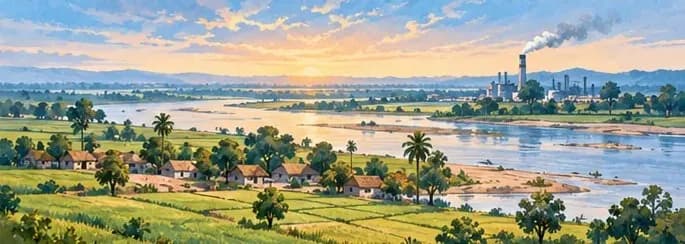
A wide view of the Gangetic plain in Bihar at dawn, lush paddy fields beside a broad river, with a small village and a distant factory chimney
Which question?2020Constraints on Bihar’s rapid development and how to remove them (65th BPSC, 2020)2007“Natural disasters are the main causes of poverty in Bihar” (47th BPSC, 2007)2001Bihar backward despite its possibilities (2001) / slow industrial development (1995)
2020

Since independence, Bihar has been among the most economically backward states of India. Even though remarkable growth has been recorded in recent years (e.g. in 2019–20 Bihar recorded a double-digit growth rate of 10.5 per cent, higher than the Indian economy’s 4.2 per cent in the same fiscal year), Bihar still remains the poorest state, with per capita income less than a third of the national average.

2007

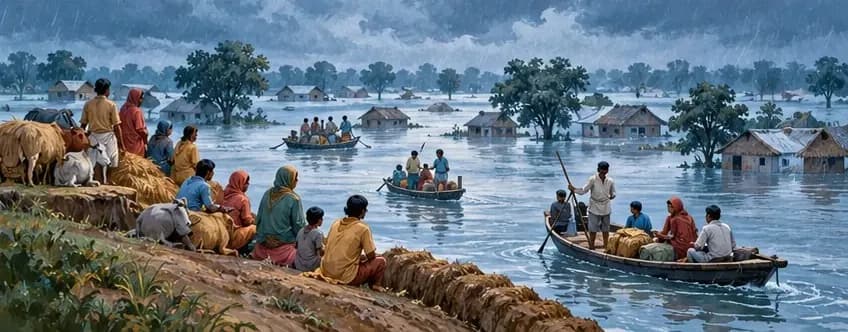
Bihar faces multiple natural disasters — for example floods, droughts, earthquakes, cyclones, heat waves, cold waves, landslides, etc. Bihar has a long history of disaster: e.g. a very severe earthquake in 1934 devastated a major part of Bihar, and frequent annual floods take a huge toll on life and property.

These disasters are considered one of the main reasons for poverty in Bihar. However, there are other reasons for Bihar’s current economic condition, including policy shortcomings, the state of education and skills, its geographical position (away from the coast), social issues, etc.

2001

India has experienced impressive economic growth since the 1990s. Its growth pattern, however, is uneven. While states like Maharashtra, Punjab, Haryana and Gujarat developed fast, Bihar has lagged behind.

Even though it has huge human resources, some of the most fertile land in the world and rich natural resources (before the creation of Jharkhand), it has remained one of the most backward states in India. This is because of several reasons, like the agricultural nature of its economy, fragmented land, backward technology, policies like freight equalisation, and a lack of institutional, physical and social infrastructure. Because of its backward economy, it has been categorised among the BIMARU (‘sick’ in Hindi) states.

Persons per km² (2011)

  • Bihar1,106
  • India382

Per capita income (Rs)

  • Bihar43,000
  • India1,35,000

Poverty ratio (%)

  • Bihar33.7%
  • India21.9%

Road km per lakh people

  • Bihar181
  • India386
“There is need of active contribution from all sections of society towards the realisation of the vision of a prosperous Bihar.”
— On Bihar’s development

Curated for BPSC, UPSC & State PCS Civil Services Aspirants | Indian & Bihar Economy Master Module