


EDU TERIA Logo
CartSign InSign UpEnroll Now
BPSC Mains GS-2 Masterclass · Indian Economy

Achievements of Indian PlanningAnd the Changes Planning Needed

In 1951 India faced mass poverty, food shortage, illiteracy and a weak industrial base, and chose planning as the answer. Twelve Five-Year Plans later, what did planning achieve, where did it fall short, and why did India replace the Planning Commission with NITI Aayog?

Institutions1950Planning Commission

set up by Nehru; replaced by NITI Aayog.

Agriculture51 → 292 MTFoodgrains

From the First Plan to 2019-20.

Education12% → 74%Literacy

From 1947 to Census 2011.

Energy1,362 MW → 373 GWPower capacity

From 1947 to the present grid.

Roads21,000 → 1.42 lakh kmNational highways

From 1947 to 2019.

New model15–7–3Vision–Strategy–Agenda

years: NITI Aayog's planning documents.

Part 1 · Planning for development

Why India Chose Planning, and How It Works

The problems at independence, the steps of economic planning, and the architects who designed India's plans.

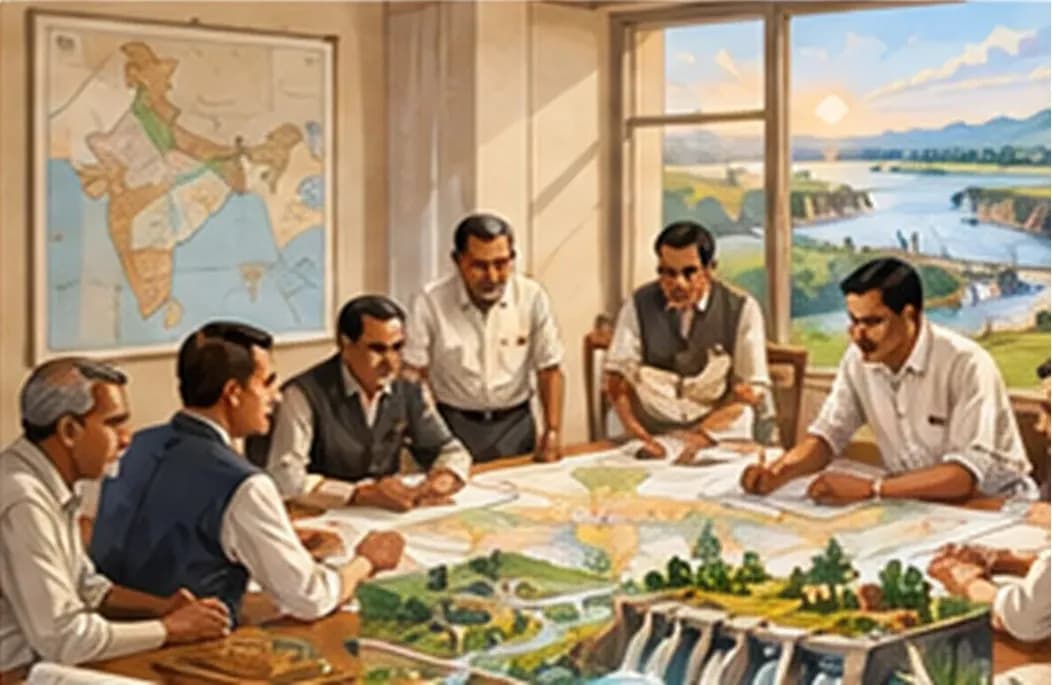
Planners around a large table in the 1950s with maps of dams, steel plants and fields spread out

Problems at independence

After the independence, there were numerous problems before Indian government. Besides mass poverty and inequality there was the problem of food shortage and inflation. Illiteracy, lack of health care, lack of infrastructure, low productivity in agriculture and storage of food grains etc. were other serious problems facing the country.

Since these were to be solved over the long period, 'Planning' for economic development was the answer to solve these problems.

Structural change in planning

Structural change in economic planning means the dramatic shift in the way economic planning is done. The new economic developments, global shifts in the economic scenario, changes in resource availability and technological innovation etc all create the condition for the need of necessary structural change in the successful economic planning.

Economic planning: the steps

Economic planning is a process which involves the following steps (this part can be skipped in the exam answer):

  • Preparing a list of the problems facing the economy.
  • Rearranging the list on the basis of priority.
  • The next step is to identify the problems which are to be solved in the immediate short run and the other problems which are to be addressed over the long period.
  • Fixing a target to achieve the desired goal.
    • The target could be a specified time period within which the problem must be solved.
  • Estimating the amount of resources needed for achieving the target. Resources include financial resource, human resource, physical resource etc.
  • Mobilizing the resources, both financial and human, is another important task. This means that the planners must know the sources of arranging the required resources.
  • Once the resources are arranged, implementation and execution process starts in an organized manner to achieve the desired goal.

    Example: Like a family planning a wedding: list what is needed, decide what comes first, set a date, estimate the cost, arrange the money, then carry it out.

Five-Year Plans and the Planning Commission

  • Indian government adopted five year plan starting from first five year plan in 1951 for development. The idea was to make a list of important problems to be solved keeping in view the given resources and the capacity to arrange the resources. Then make a review after five years of what has been done and rectify the mistakes accordingly in the next five year plan period and so on.
  • Some of the great architects of Indian planning include Jawaharlal Nehru, P.C. Mahalanobis, D.R. Gadgil, V.K.R.V. Rao. After becoming the first prime minister of independent India, Nehru established the Planning Commission in 1950.
  • The major function of the Planning Commission was to formulate plans keeping in view the resources of the country and suggesting the best methods to utilize them effectively and in a balanced manner.
“While we have achieved several mile-stones, we still have a long way to go to become a developed country.”
— BPSC Mains answer, 2019

Curated for BPSC, UPSC & State PCS Civil Services Aspirants | Indian Economy Master Module