Why in News?
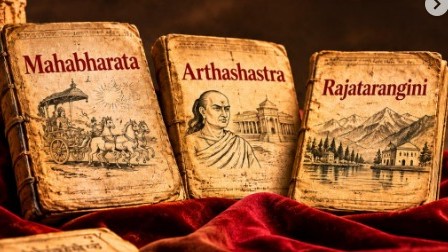
Three of India's greatest treasures, Kalhana's Rajatarangini, the Mahabharata, and Kautilya's Arthashastra, have now been added to UNESCO's Memory of the World Regional Register for Asia and the Pacific.
It is a proud moment because these are not just old books. They are the memory of our civilization.
About UNESCO
UNESCO stands for the United Nations Educational, Scientific and Cultural Organization. It is a specialized agency of the United Nations (UN) founded on November 16, 1945, with its permanent headquarters in Paris, France.
Key Points:
The decision was taken at the 11th General Meeting of MOWCAP, held in Jakarta, Indonesia.
India's total now: With these 3 new additions, India now has 6 inscriptions in the regional register.
Earlier inscriptions in 2024: Ramcharitmanas, Panchatantra, and Sahrdayaloka-Locana.
The Three Treasures
India's three newly recognized manuscripts represent three pillars of our civilization—history, values, and governance. Each one comes from a different time and place, but together they tell the complete story of India.
Rajatarangini:
Written by Kalhana in the 12th century.
It is a Sanskrit historical chronicle of Kashmir, documenting its rulers and political history.
The manuscript is preserved at the Oriental Research Library, Srinagar.
Mahabharata:
Traditionally attributed to Vyasa.
It is one of India's two major Sanskrit epics, exploring Dharma, duty, and morality.
The inscribed manuscript is 400 years old, written on birchbark in Sharada script.
It is preserved at the Bhandarkar Oriental Research Institute, Pune.
Artha Shastra:
Traditionally attributed to Kautilya (Chanakya). It is an ancient treatise on governance, administration, diplomacy, economics, and statecraft.
Its inscribed manuscript is from the 16th century and written on palm leaf.
It is preserved at the Oriental Research Institute, Mysuru.
Role of IGNCA:
UNESCO Memory of the World Programme
Established and Objective:
Launched by UNESCO in 1992. Its aim is to preserve documentary heritage, especially heritage threatened by conflicts and natural disasters.
It also works to ensure universal access and to make people aware of why these documents matter.