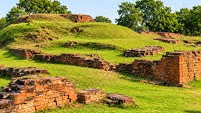
Bihar’s Ranivas Mound Declared a Monument of National Importance
Eduteria Insights · 12 Nov 2026
Why in News?
The Central Government has declared Bihar’s Ranivas Mound an archaeological site of national importance through a notification .
Key Highlights
Location: Kesariya, East Champaran district, Bihar.
Area: 1.63 acres.
Ownership: Government of Bihar.
Authority: Archaeological Survey of India (ASI), Ministry of
Ranivas Mound is believed to have been part of an important Buddhist monastic establishment near Kesariya Stupa.
Excavations by the ASI revealed remains of ancient walls, rooms, cells and corridors, indicating the existence of a Buddhist monastery.
Kesariya Stupa is traditionally associated with Lord Buddha's journey from Vaishali towards Kushinagar before his Mahaparinirvana
The declaration was made under Section 4(3) of the Ancient Monuments and Archaeological Sites and Remains (AMASR) Act, 1958.
Why is it called Raniwas Mound?
Raniwas literally means “Queen's Residence” or “Queen's Palace”.
According to local folklore, King Vena's queen, Kamalavati, drowned in a nearby pond.
The king was deeply distressed by her death and, according to the legend, immolated himself along with his family inside the nearby mound.
Another local tradition associates the mound with the place where Queen Kamalavati lived.
Therefore, the mound came to be known locally as Raniwas (Queen's Residence).
Significance
In 1861, Alexander Cunningham, the first Director-General of ASI, explored the mound and reported the existence of an ancient Buddhist establishment with a temple containing a huge Buddha image.
Helps protect Bihar's archaeological and historical heritage.
Promotes archaeological research and conservation.
Currently, 70 sites in Bihar are under the stewardship of the Archaeological Survey of India.
- Ranivas Mound Eduteria
- Ranivas Mound
- About Ranivas Mound
Swipe up (or press ↓) for the next news