
TIMELINE III - (c. 1300 TO 1700)
III
CHANGING TRADITIONS
The Three Orders
Changing Cultural Traditions
CHANGING TRADITIONS
WE have seen how, by the ninth century, large parts of Asia witnessed the growth and expansion of great empires – some nomadic, some based on well-developed cities and trading networks that centred on them. The difference between the Macedonian, Roman and Arab empires and the ones that preceded them (the Egyptian, Assyrian, Chinese, Mauryan) was that they covered greater areas of territory, and were continental or transcontinental in nature. The Mongol empire was similar.
Different cultural encounters were crucial to what took place. The arrival of empires was almost always sudden, but they were almost always the result of changes that had been taking place over a long time in the core of what would become an empire.
Traditions in world history could change in different ways. In western Europe during the period from the ninth to the seventeenth centuries, much that we connect with modern times evolved slowly – the development of scientific knowledge based on experiment rather than religious belief, serious thought about the organisation of government, with attention to the creation of civil services, parliaments and different codes of law, improvements in technology that was used in industry and agriculture. The consequences of these changes could be felt with great force outside Europe.
As we have seen, by the fifth century CE, the Roman Empire in the west had disintegrated. In western and central Europe, the remains of the Roman Empire were slowly adapted to the administrative requirements and needs of tribes that had established kingdoms there. However, urban centres were smaller in western Europe than further east.
By the ninth century, the commercial and urban centres – Aix, London, Rome, Sienna – though small, could not be dismissed. From the ninth to the eleventh centuries, there were major developments in the countryside in western Europe. The Church and royal government developed a combination of Roman institutions with the customary rules of tribes. The finest example was the empire of Charlemagne in western and central Europe at the beginning of the ninth century. Even after its rapid collapse, urban centres and trading networks persisted, albeit under heavy attack from Hungarians, Vikings and others.
What happened was called ‘feudalism’. Feudalism was marked by agricultural production around castles and ‘manor houses’, where lords of the manor possessed land that was cultivated by peasants (serfs) who pledged them loyalty, goods and services. These lords in turn pledged their loyalty to greater lords who were ‘vassals’ of kings. The Catholic Church (centred on the papacy) supported this state of affairs and itself possessed land. In a world where uncertainties of life, poor sense of medicine and low life expectancy were common, the Church showed people how to behave so that life after death at least would be tolerable. Monasteries were created where God-fearing people could devote themselves to the service of God in the way Catholic churchmen thought fit. Equally, churches were part of a network of scholarship that ran from the Muslim states of Spain to Byzantium, and they provided the petty kings of Europe with a sense of the opulence of the eastern Mediterranean and beyond.
The influence of commerce and towns in the feudal order came to evolve and change encouraged by Mediterranean entrepreneurs in Venice and Genoa (from the twelfth century). Their ships carried on a growing trade with Muslim states and the remains of the Roman Empire in the east. Attracted by the lure of wealth in these areas, and inspired by the idea of freeing ‘holy places’ associated with Christ from Muslims, European kings reinforced links across the Mediterranean during the ‘crusades’. Trade within Europe improved (centred on fairs and the port cities of the Baltic Sea and the North Sea and stimulated by a growing population).
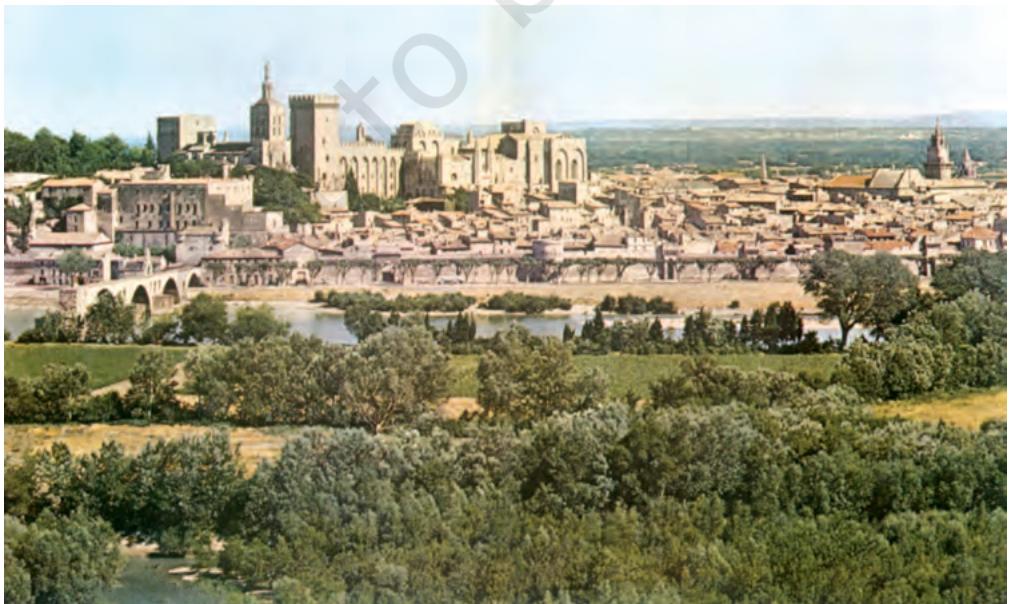
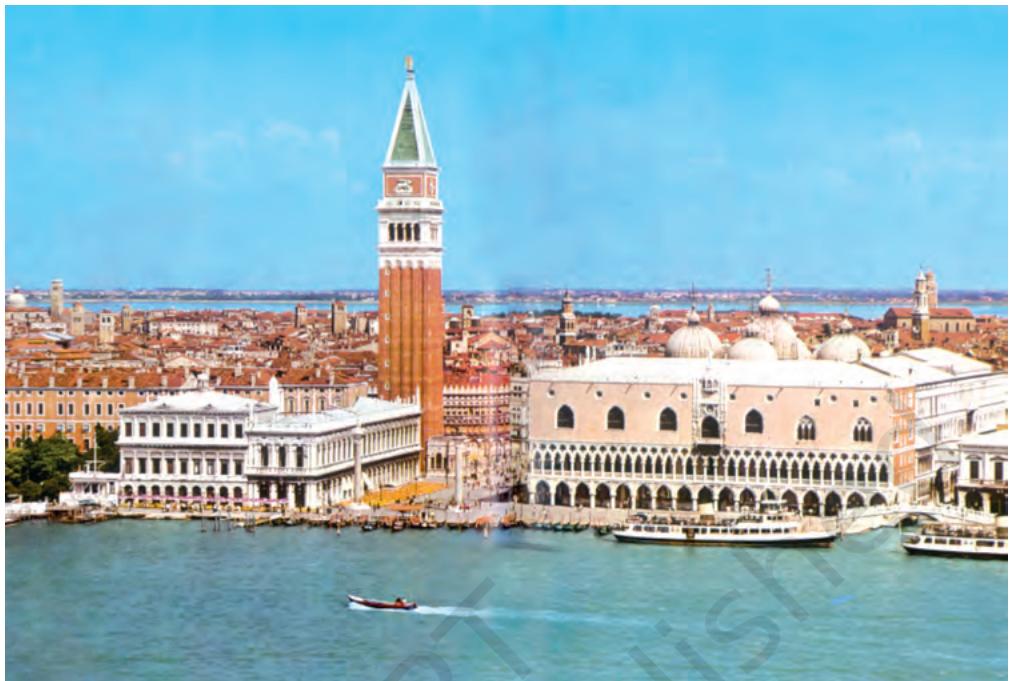
The Palace of the Doge, in Venice, fifteenth century.
Opportunities for commercial expansion coincided with changing attitudes concerning the value of life. Respect for human beings and living things that marked much of Islamic art and literature, and the example of Greek art and ideas that came to Europe from Byzantine trade encouraged Europeans to take a new look at the world. And from the fourteenth century (in what is called the ‘Renaissance’), especially in north Italian towns, the wealthy became less concerned with life after death and more with the wonders of life itself. Sculptors, painters and writers became interested in humanity and the discovery of the world.
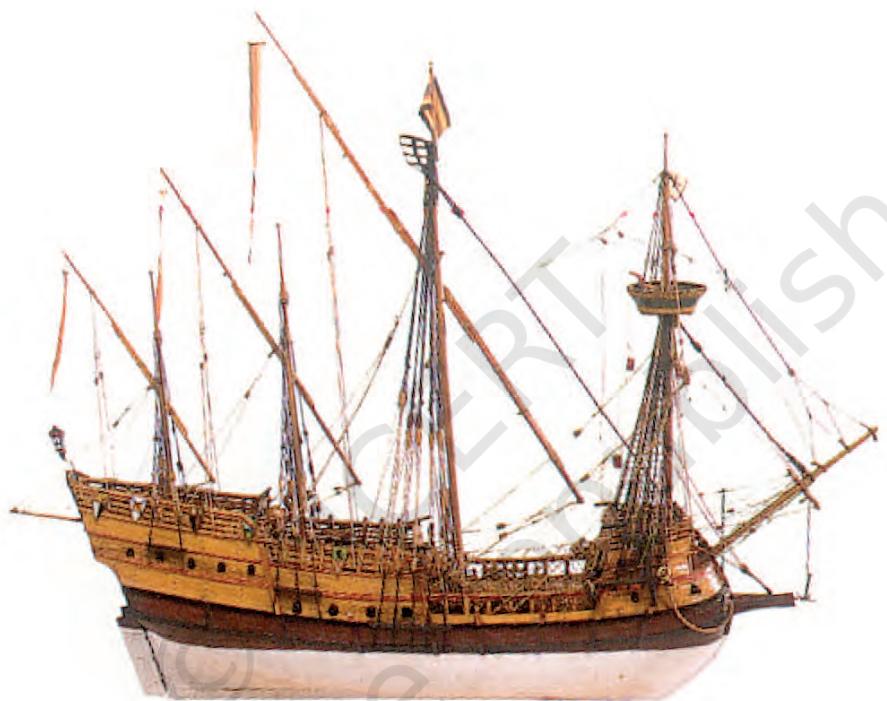
By the end of the fifteenth century, this state of affairs encouraged travel and discovery as never before. Voyages of discovery took place. Spaniards and Portuguese, who had traded with northern Africa, pushed further down the coast of western Africa, finally leading to journeys around the Cape of Good Hope to India – which had a great reputation in Europe as a source of spices that were in great demand. Columbus attempted to find a western route to India and in 1492 reached the islands which the Europeans called the West Indies. Other explorers tried to find a northern route to India and China via the Arctic.
European travellers encountered a range of different peoples in the course of their journeys. In part, they were interested in learning from them. The papacy encouraged the work of the North African geographer and traveller Hasan al-Wazzan (later known in Europe as Leo Africanus), who wrote the first geography of Africa in the early sixteenth century for Pope Leo X. Jesuit churchmen observed and wrote on Japan in the sixteenth century. An Englishman, Will Adams, became a friend and counsellor of the Japanese Shogun, Tokugawa Ieyasu, in the early seventeenth century. As in the case of Hasan al-Wazzan, peoples that the Europeans encountered in the Americas often took a great interest in them and sometimes worked for them. For example an Aztec woman – later known as Dona Marina – befriended the Spanish conqueror of Mexico, Cortes, and interpreted and negotiated for him.
In their encounters, Europeans were sometimes cautious, self-effacing and observant, even as they frequently attempted to establish trade monopolies and enforce their authority by force of arms as the Portuguese attempted to do in the Indian Ocean after Vasco da Gama's arrival in Calicut (present-day Kozhikode) in 1498. In other cases, they were overbearing, aggressive and cruel and adopted an attitude of superiority to those they met, considering such people ignorant. The Catholic Church encouraged both attitudes. The Church was the centre for the study of other cultures and languages, but encouraged attacks on people it saw as ‘un-Christian’.
From the point of view of non-Europeans, the encounter with Europe varied. For much of the Islamic lands and India and China, though, Europeans remained a curiosity until the end of the seventeenth century. They were perceived as hardy traders and seamen who had little to contribute to their sense of the larger world. The Japanese learnt some of the advantages of European technology quickly – for instance, they had begun large-scale production of muskets by the late sixteenth century. In the Americas, enemies of the Aztec empire sometimes used Europeans to challenge the power of the Aztecs. At the same time the diseases the Europeans brought devastated the populations, leading to the death of over 90 per cent of the people in some areas by the end of the sixteenth century.
TIMELINE III
(c. 1300 TO 1700)
The period under consideration witnessed several major developments in Europe, including changes in agriculture and the
lives of peasants. It was also marked by a range of cultural developments. This timeline draws attention to contacts between continents, stimulated in many instances by the growth of trade. The impact of these contacts was varied – while ideas, inventions and goods were shared across continents, there was also constant warfare between kingdoms to control land, resources and access to trade routes. As a result, men and women were often displaced and enslaved, if not exterminated. In many ways, the lives of people were transformed beyond recognition.
| DATES | AFRICA | EUROPE | |
| 1300-25 | Alhambra and Granada emerge as important cultural centres in Spain | ||
| 1325-50 | Plague* in Egypt (1348-55) | Hundred Years War between England and France (1337-1453); Black Death (a form of plague) spreads throughout Europe (1348) | |
| 1350-75 | Ibn Batuta explores the Sahara | French peasants protest against high taxes (1358) | |
| 1375-1400 |  | Peasant revolt in Britain (1381); Geoffrey Chaucer writes The Canterbury Tales, one of the earliest compositions in English (1388) | |
| 1400-25 | |||
| 1425-50 | Portuguese begin slave trading (1442) | ||
| 1450-75 | Songhai empire in West Africa established based on trading networks across the Sahara; Portuguese expeditions and settlements along the west coast of Africa (1471 onwards) | First printed book appears in Europe; Leonardo da Vinci (1452-1519), painter, architect, inventor in Italy | |
| 1475-1500 | Portuguese convert the king of Bokongo to Christianity | Establishment of the Tudor dynasty in England (1485) | |
| 1500-25 | African slaves taken to work on sugar plantations in America (1510); Ottoman Turks conquer Egypt (1517) | Coffee from South America is drunk in Europe for the first time (1517) and tobacco, chocolate, tomatoes and turkey are also introduced; Martin Luther attempts to reform the Catholic Church (1517) | |
| 1525-50 |  | Copernicus propounds theory about solar system (1543) | |
| 1550-75 | William Shakespeare (1564-1616), dramatist in England | ||
| 1575-1600 | Zacharias Janssen invents the microscope (1590s) | ||
| 1600-25 | Oyo kingdom of Nigeria at the height of its power, centres for metal-working* | One of the first novels, Don Quixote, written in Spanish (1605) | |
| 1625-50 | William Harvey demonstrates that blood is pumped through the body by the heart (1628) | ||
| 1650-75 | Portuguese destroy the Kongo kingdom (1662) | Louis XIV, king of France (1638-1715) | |
| 1675-1700 | Peter the Great (1682-1725) attempts to modernise Russia | ||
| DATES | ASIA | SOUTH ASIA | |
| 1300-25 | |||
| 1325-1350 | Establishment of the Vijayanagara empire* (1336) | ||
| 1350-75 | Ming dynasty* in China (1368 onwards) | ||
| 1375-1400 | |||
| 1400-25 |  | Emergence of regional sultanates | |
| 1425-50 | |||
| 1450-75 | Ottoman Turks capture Constantinople (1453) | ||
| 1475-1500 | Vasco da Gama reaches India (1498) | ||
| 1500-25 | Portuguese entry into China opposed, driven out to Macao (1522) | ||
| 1525-50 | Babur establishes Mughal control over north India, first battle of Panipat (1526) | ||
| 1550-75 | Akbar (1556-1605) consolidates Mughal rule | ||
| 1575-1600 | First Kabuki play staged in Japan (1586); Shah Abbas (1587-1629) of Persia introduces European methods of military training | ||
| 1600-25 | Tokugawa Shogunate established in Japan (1603) | Establishment of the British East India Company (1600) | |
| 1625-50 | All European traders with the exception of the Dutch forbidden to trade with Japan (1637); Manchu rule in China, (1644 onwards) which lasts for nearly 300 years; growing demand in Europe for Chinese tea and silk | Construction of the Taj Mahal ( 1632-53) | |
| 1650-75 | |||
| 1675-1700 |  | ||
| DATES | AMERICAS | AUSTRALIA/PACIFIC ISLANDS | |
| 1300-25 | Aztec capital at Tenochtitlan, Mexico (1325), building temples, development of irrigation systems and accounting system (quipu)* |  | |
| 1325-50 |  | ||
| 1350-75 | |||
| 1375-1400 | |||
| 1400-25 | |||
| 1425-50 | |||
| 1450-75 | Incas establish control over Peru (1465) | ||
| 1475-1500 | Columbus reaches the West Indies (1492) | ||
| 1500-25 | Spanish conquest of Mexico (1521) | Magellan, a Spanish navigator, reaches the Pacific Ocean (1519) | |
| 1525-50 | French explorers reach Canada (1534) | ||
| 1550-75 | Spanish conquest of Peru (1572) | ||
| 1575-1600 | Dutch sailors reach Australia by accident | ||
| 1600-25 | England sets up its first colonies in North America (1607); the first slaves are brought from West Africa to Virginia (1619) | Spanish sailors reach Tahiti (1606) | |
| 1625-50 | Dutch found New Amsterdam, now called New York (1626); first printing press is set up in Massachusetts (1635) | Dutch navigator Abel Tasman sails around Australia without realising it. He then lands on Van Diemen's land, later called Tasmania. He also reaches New Zealand, but thinks it is part of a huge landmass! | |
| 1650-75 | First sugar plantations are established in the West Indies (1654) | ||
| 1675-1700 | French colonise the Mississippi basin, naming it Louisiana after King Louis XIV (1682) | ||
| ACTIVITYYou may have noticed that the column on Australia/Pacific Islands has very few recorded dates. This is because the peoples in these areas often used other forms of recording, including paintings such as the one shown above*. List at least one event/process from each of the preceding five columns which an Australian painter may have found worth recording. List another five which may have seemed irrelevant to her/him. | |||